Day 1 Convective Outlook
NWS Storm Prediction Center Norman OK
1250 AM CDT Tue Jun 16 2026
Valid 161200Z - 171200Z
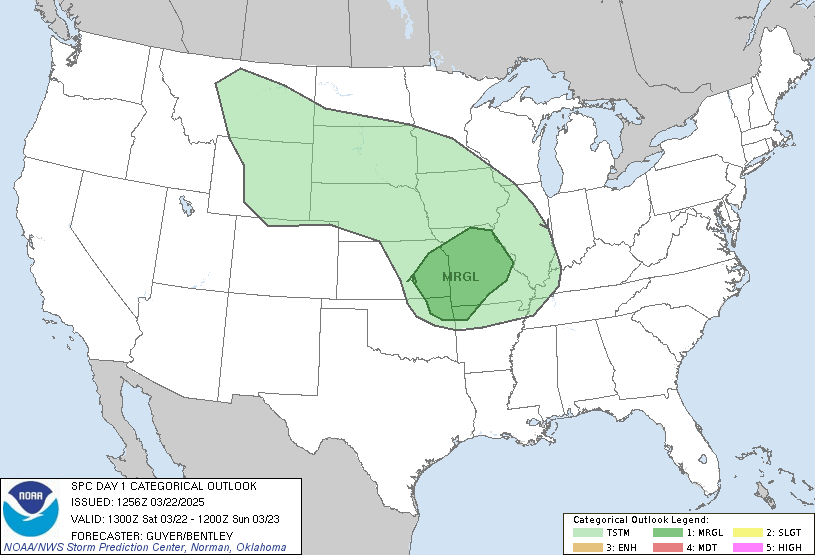
...THERE IS A MARGINAL RISK OF SEVERE THUNDERSTORMS TODAY THROUGH
TONIGHT ACROSS PARTS OF THE NORTHERN GREAT PLAINS INTO MIDWEST AND
NEAR THE GULF COAST...
...SUMMARY...
Areas of mainly widely scattered strong thunderstorm development,
accompanied by at least some risk for severe weather, are possible
across parts of the northern Great Plains into Midwest and near the
Gulf Coast vicinity today through tonight.
...Discussion...
Higher latitude blocking appears likely to maintain a broad area of
cyclonic mid-level flow with anomalously low heights to the lee of
the northern Rockies through the northern and middle Atlantic
Seaboard. Within this regime, models suggest that an initially
vigorous short wave trough (now digging into the Upper Midwest) may
maintain strength into and across the Lake Michigan vicinity, before
undergoing considerable deformation while turning eastward and
northeastward, to the southeast of a mid-level becoming centered
near the northern Manitoba/northwestern Ontario border. After
rounding the crest of mid-level ridging centered over the northern
mid-latitude eastern Pacific, it appears that another significant
short wave perturbation will dig through the broadly confluent
regime to the southwest of the low, across the northern Rockies
through northern Great Plains by late tonight.
In lower latitudes, mid/upper ridging emanating from the subtropical
Atlantic may maintain considerable influence across the Florida
peninsula today, while weak troughing, perhaps with a developing
mid-level cyclonic circulation, slowly pivots across the lower Texas
and Mexican Gulf coast.
In lower levels, seasonably high boundary-layer moisture content has
generally been maintained across much of the Gulf coastal plain. It
appears that strengthening southerly low-level flow may support more
substantive moisture return to the southeast of deepening surface
troughing across the northern into central Great Plains by late
tonight.
...Midwest/Great Lakes...
Weak convection accompanying forcing for ascent associated with the
lead short wave trough appears likely to persist and perhaps
increase across the Upper Midwest through Great Lakes and Ohio
Valley during the day. Coinciding low-level cooling is likely to at
least slow, if not inhibit, boundary layer warming in the wake of
this activity. However, various model output suggests that
associated low-level moistening, coupled with a period of insolation
beneath a developing mid-level dry slot, may be sufficient to
support a corridor of modest destabilization as the mid-level cold
pool (including 500 mb temperatures around -18 to -20C) overspreads
the southern Lake Michigan vicinity late this afternoon. This
environment might become sufficient for a developing broken band of
vigorous convection, perhaps including supercells, posing a risk for
severe hail/wind and possibly a tornado or two, before weakening
later this evening.
...Central Great Plains...
Forcing for ascent to support convective development along the
stalling cold front, trailing the short wave trough progressing into
the Great Lakes/Ohio Valley, remains unclear. However, there
appears a general consensus within model output that boundary-layer
moistening may support CAPE on the order of 1000-2000 J/kg across
parts of southern Kansas into southwestern Missouri, where mid-level
inhibition may remain weak enough through late afternoon/early
evening to allow for isolated/widely scattered thunderstorm
initiation. If this occurs, guidance indicates sufficient shear for
supercell development, before increasing inhibition suppresses
convection later this evening.
...Gulf Coast...
Models indicate modest strengthening of westerly flow (including
20-40 kt in the 850-500 mb layer) in a belt across the north central
through northeastern Gulf coast vicinity today. Coinciding with
destabilization driven by daytime heating of the seasonably moist
boundary layer, this may support modestly organizing convection,
perhaps transient supercell structures, posing a risk for damaging
wind gusts and perhaps an isolated tornado or two.
...Northern Great Plains into Midwest...
Models suggest that a corridor of fairly deep boundary-layer mixing
will precede the vigorous short wave trough digging across and
east-southeast of the Canadian/northern U.S. Rockies. It appears
that associated mid-level forcing for ascent will contribute to
sufficient destabilization to support scattered thunderstorm
development with potential to produce some hail and scattered strong
to severe surface gusts late this afternoon into evening.
Within strengthening downstream warm advection, forcing for ascent
may begin to interact with better elevated moisture return to
support increasing strong thunderstorm development with potential to
producing severe hail by late tonight, across parts of eastern Iowa
and adjacent portions of the Midwest.
..Kerr/Weinman.. 06/16/2026
Read more CHECK UPDATE ZOOM GRAPHIC
http://dlvr.it/TT3fBb