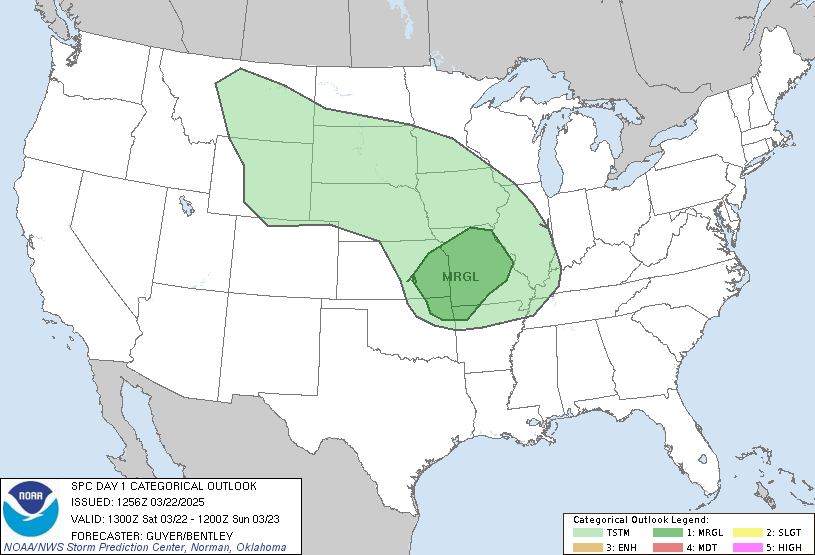
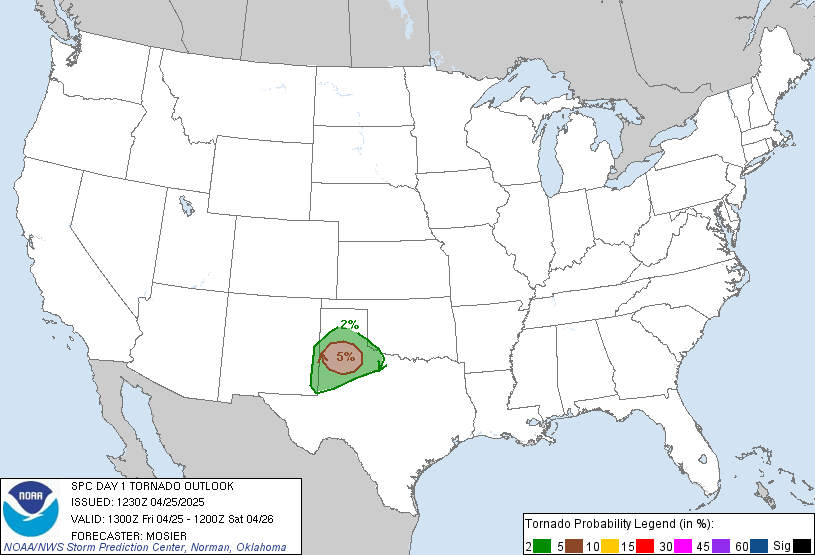
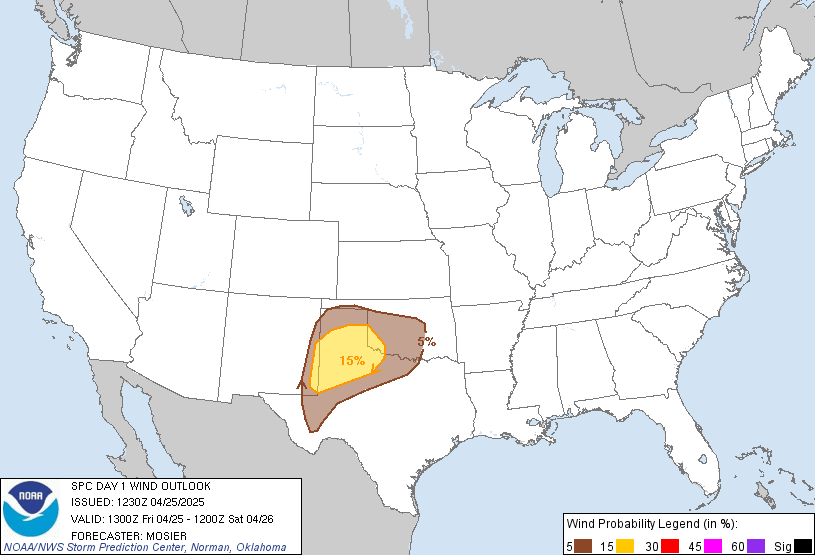
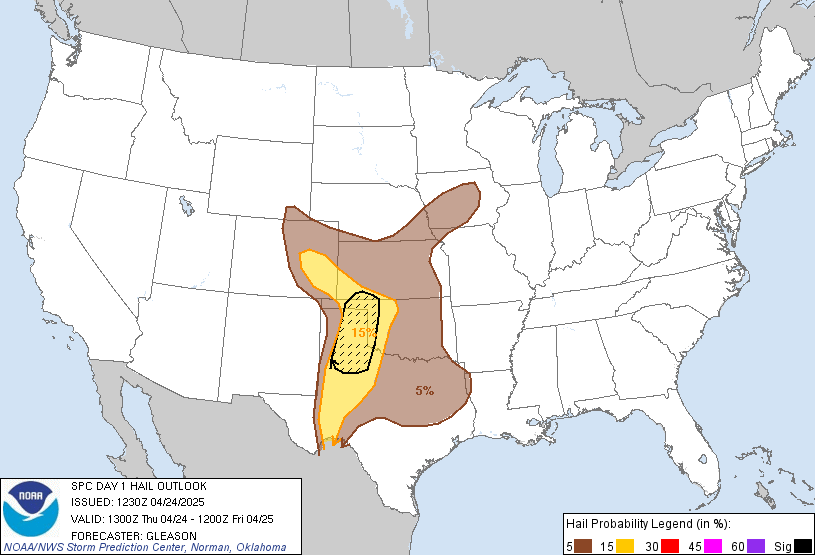
Day 1 Convective Outlook
NWS Storm Prediction Center Norman OK
1232 AM CDT Thu May 07 2026
Valid 071200Z - 081200Z
...THERE IS A SLIGHT RISK OF SEVERE THUNDERSTORMS ACROSS SOUTHEAST
ALABAMA INTO PORTIONS OF SOUTH GEORGIA AND NORTH FLORIDA...INCLUDING
THE PANHANDLE...
...SUMMARY...
Widely scattered severe storms capable of damaging winds and a
couple tornadoes are possible Thursday across southeast Alabama, and
portions of south Georgia and north Florida, including the
Panhandle. Isolated strong to severe storms are also possible in
parts of the Carolinas, as well as the lower Rio Grande Valley and
deep South Texas.
...Synopsis...
Separate vorticity maxima over the northern Plains and Raton Mesa
vicinity this evening are forecast to phase while progressing
through the southern periphery of broader-scale troughing present
across eastern Canada into the OH Valley and Northeast. That pattern
evolution will contribute to more substantial height falls from the
mid-Atlantic into the southern Appalachians and Southeast on
Thursday. Strong, mid/upper-level flow will be maintained within the
base of the deepening trough from the lower-MS Valley into the
Southeast and mid-Atlantic region.
At the surface, a cold front is expected to initially stretch from
the Tidewater region to diffuse low pressure over the western
Carolinas into northeast GA, and then southwest to the central Gulf
Coast. That boundary will slowly advance southeast through the day,
with that feature along with any convective outflow boundaries
serving as the foci for strong to severe storm development.
...Carolinas to northeast Gulf Coast...
Convection-allowing model guidance suggests that a
west-to-east-oriented, pre-frontal band of thunderstorms will be
ongoing at the start of the forecast period (07/12z) across southern
AL and the FL Panhandle into southern GA, rooted within a
warm-advection regime along a 40-50 kt low-level jet. The low-level
jet will aid in the northeastward advection of an increasingly moist
boundary layer from off the northeast Gulf with dewpoints increasing
into the low 70s within the inflow region of the early-day storms.
That moisture will largely contribute to MLCAPE of 500-1000 J/kg,
despite poor mid-level lapse rates.
The presence of the low-level jet will support initially strong
near-ground shear (i.e., effective SRH of 200-300 m2/s2) within the
instability axis preceding the storms. However, that feature is
forecast to gradually weaken while migrating east through the
morning, with seemingly the best tornado potential existing during
the first few hours of the forecast period. Otherwise, damaging wind
gusts will be the primary hazard as storms progress southeast
through the level 2/Slight Risk area.
Farther to the northeast across the NC/SC Piedmont and Coastal
Plain, poor lapse rates are expected to limit instability to
generally less than 500 j/kg. However, deep-layer wind fields will
be strong, suggesting the potential for locally strong wind gusts
with any deeper convective elements forming along and ahead of the
cold front from late morning into afternoon.
...Lower Rio Grande Valley/deep South Texas...
There is a model signal for at least isolated thunderstorm
development at the start of the forecast period (07/12z) with the
location of the storms varying from model to model. RAP-based
soundings suggest that the storms would be slightly elevated above a
stable, near-surface layer within a moderately unstable environment
with MUCAPE up to 1000-1500 J/kg. While mid-level lapse rates aren't
expected to be particularly steep, the presence of 50-60+ kt
effective bulk shear magnitudes would support the potential for
supercell structures capable of isolated occurrences of large hail
and locally damaging wind gusts. The severe-weather threat is expect
to remain confined to the morning hours.
..Mead/Lyons.. 05/07/2026
Read more CHECK UPDATE ZOOM GRAPHIC
http://dlvr.it/TSQ9H8