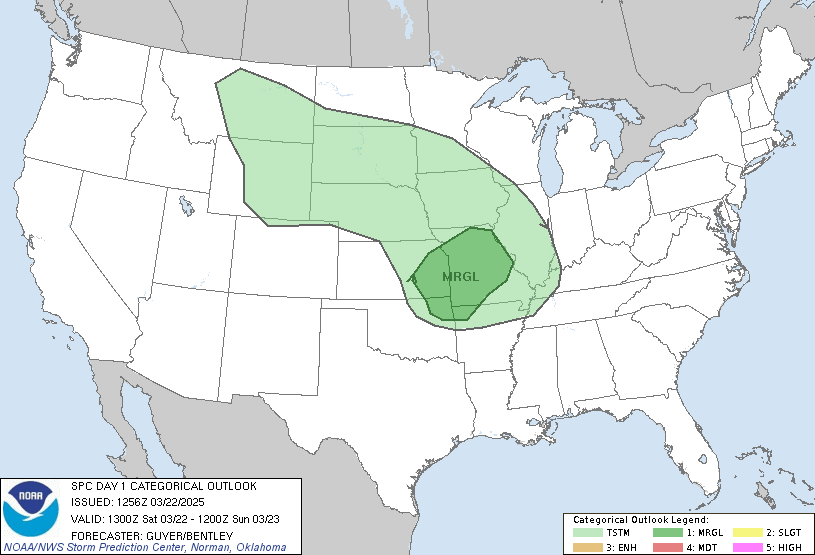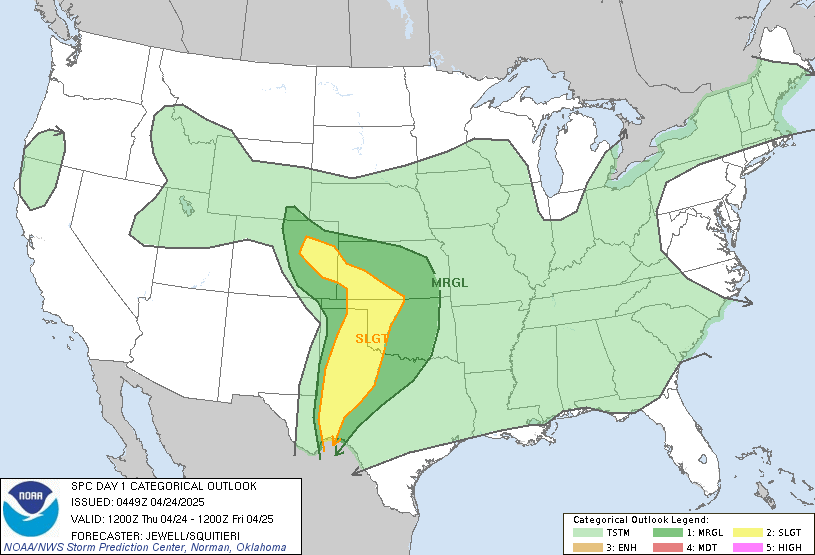
Day 1 Convective Outlook
NWS Storm Prediction Center Norman OK
1100 PM CST Sun Jan 04 2026
Valid 051200Z - 061200Z
...NO SEVERE THUNDERSTORM AREAS FORECAST...
...SUMMARY...
The risk for thunderstorms will remain minimal across the U.S. today
through tonight.
...Discussion...
Models indicate that mid-level flow is trending more zonal across
the northern mid-latitudes, from the Pacific to the Atlantic.
Across the southern mid- into subtropical latitudes, it appears
likely to remain more amplified through this period, with one
notable short wave trough forecast to continue digging across the
eastern Pacific. Downstream, a lower amplitude short wave trough
emerging from the Intermountain West may contribute to further
suppression of mid-level ridging as far south as the central Great
Plains into middle Mississippi Valley later today through tonight.
However, mid-level ridging is likely to be maintained across much of
the Gulf Basin and adjacent Gulf Coast, to the north of an
increasingly prominent mid-level high forming near the Yucatan
Peninsula. Farther east, broad mid-level troughing is forecast to
shift a bit further offshore of the south Atlantic Seaboard.
Beneath this regime, modest surface cyclogenesis may commence across
the central Great Plains into Midwest. This may be accompanied by
some low-level moistening off a Gulf boundary layer only slowly
modifying in the wake of recent cooling and/or drying. However,
forecast soundings indicate that this moisture return will be capped
by pronounced warm and dry layers in the lower through
mid-troposphere.
...California...
Stronger mid-level cooling and forcing for ascent downstream of the
digging offshore short wave, which could potentially become
supportive of thermodynamic profiles conducive to thunderstorms, may
approach the central California coast this morning before slowly
shifting southward near, but mostly offshore of coastal areas
through the remainder of the period.
...Great Basin into Rockies...
Guidance continues to suggest that mid-level cooling and forcing for
ascent (associated with a short wave perturbation now progressing
northeast and east of the southern Sierra Nevada) could contribute
to the evolution of thermodynamic profiles at least marginally
conducive to convection capable of producing lightning, across the
mountains of north central/northeastern Utah this morning into
northwestern Colorado/adjacent southern Wyoming later today.
...Upper Midwest...
Downstream of the short wave emerging from the Great Basin, forecast
soundings indicate that steepening lapse rates associated with
mid-level cooling and forcing for ascent, coupled with mid-level
moisture return, may support a corridor of destabilization rooted
generally around the 700 mb layer. It might not be entirely out of
the question that this could support weak convection capable of
producing lightning across the southern Minnesota through southern
Wisconsin vicinity (and adjacent portions of northern Illinois/Iowa)
tonight. However, probabilities for this still appear below the
minimum 10 percent threshold for a categorical thunder area.
..Kerr.. 01/05/2026
Read more CHECK UPDATE ZOOM GRAPHIC
http://dlvr.it/TQ8nwm