Day 1 Convective Outlook
NWS Storm Prediction Center Norman OK
0306 PM CDT Wed Jul 01 2026
Valid 012000Z - 021200Z
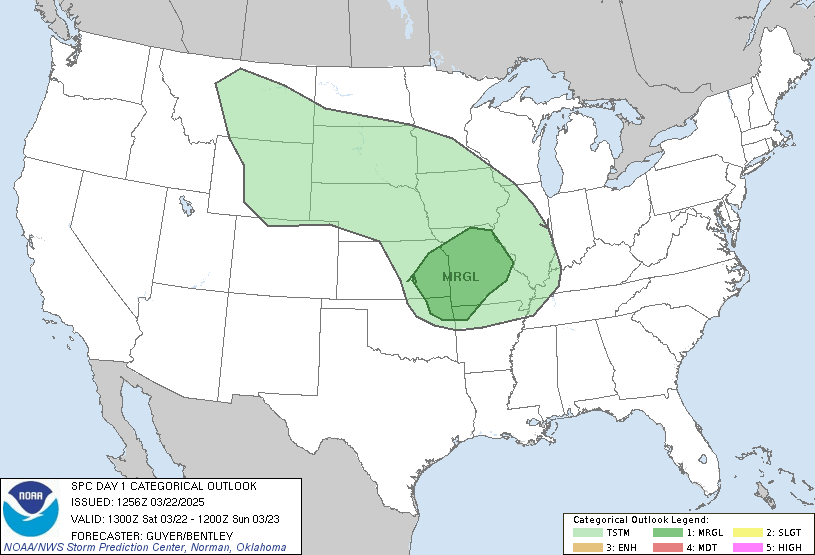
...THERE IS AN ENHANCED RISK OF SEVERE THUNDERSTORMS FOR PORTIONS OF
THE UPPER MIDWEST INTO THE GREAT LAKES...
...THERE IS A SLIGHT RISK OF SEVERE THUNDERSTORMS ACROSS PARTS OF
THE NORTHEAST...CENTRAL HIGH PLAINS...AND GULF COAST STATES...
...SUMMARY...
Multiple rounds of severe thunderstorms are still expected across
the Upper Midwest and Upper Great Lakes into tonight. A couple of
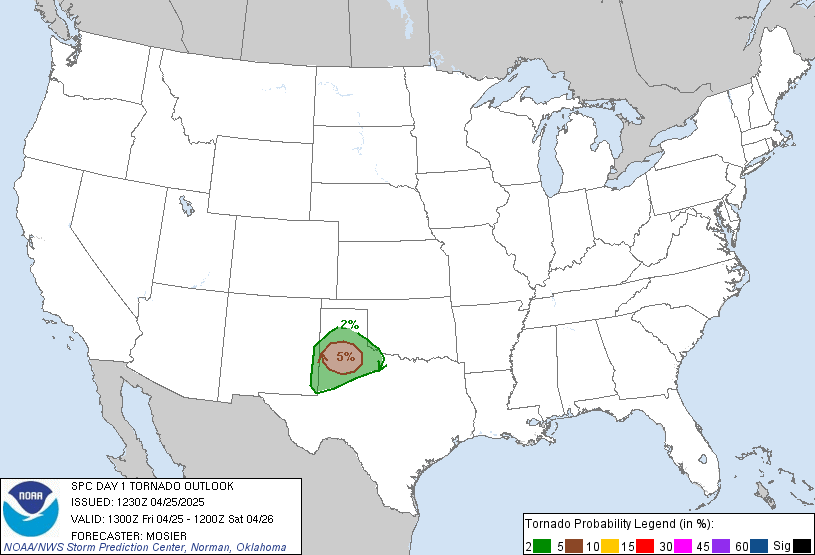
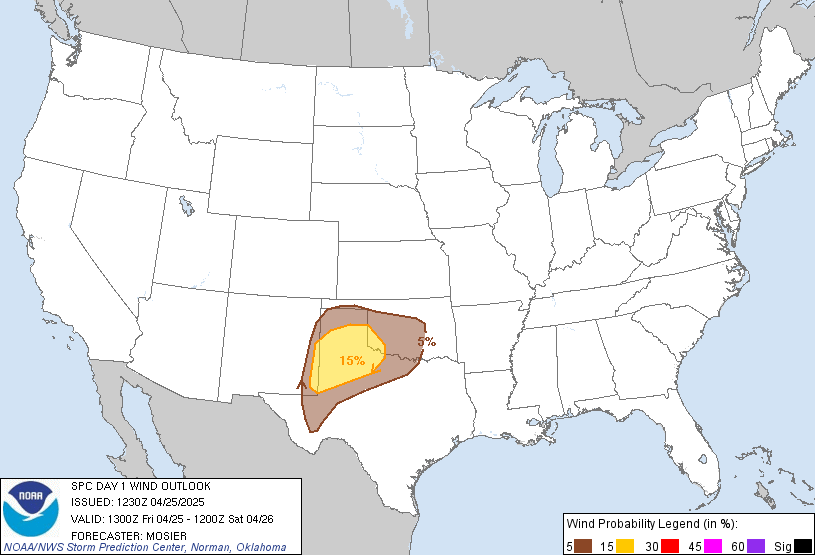
tornadoes are possible but damaging wind gusts are expected to be
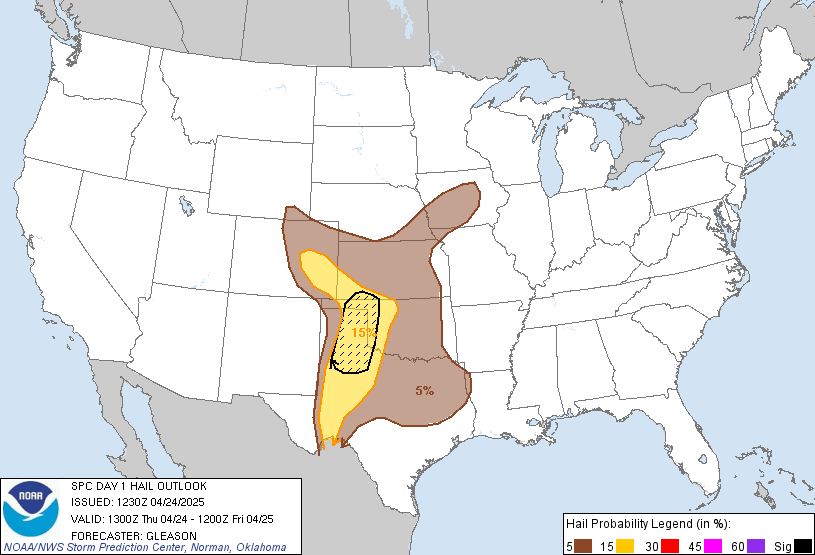
the more widespread hazard, in addition to isolated large to very
large hail. Severe storms also remain a concern across parts of the
central High Plains, Northeast, and Southeast/Tennessee Valley.
...20Z Update...
The main change made to this outlook was to expand the wind-driven
severe probabilities southward across portions of the Upper Midwest
based on observational trends. A belt of relatively thick cloud
cover exists across portions of the Midwest. However, considerable
clearing and a CU field, along with isolated thunderstorms, has
developed across eastern IA into southern WI, where appreciable
buoyancy (2000-3000 J/kg MLCAPE) and up to 40 kts of effective bulk
shear reside. Furthermore, a few of the latest WoFS runs also depict
some higher thunderstorm coverage across eastern IA into southern
WI. As such, the thinking is that organized severe potential, mainly
in the form of severe gusts, should exist across this region through
the evening.
Otherwise, the previous forecast remains on track, with relatively
minor changes made to the thunder and severe probabilities to
reflect the latest observations and guidance consensus.
..Squitieri.. 07/01/2026
.PREV DISCUSSION... /ISSUED 1156 AM CDT Wed Jul 01 2026/
...Midwest and Upper Great Lakes...
An active multi-round day of severe weather is expected across the
region through tonight. Early this afternoon, ongoing severe risks
will continue to focus across northern Michigan as well as eastern
Wisconsin, with a secondary round of severe storms potentially
spreading into Lower Michigan later this afternoon. See existing
Mesoscale Discussions/Watches for short-term details.
Severe potential later today will focus on a convectively reinforced
boundary, with a very moist and potentially unstable environment
along and south of it. Renewed deep convective development is
expected later this afternoon into tonight across northern Iowa and
southern Minnesota, and again into Wisconsin. A ribbon of moderately
strong mid-level westerlies, some of it MCV-enhanced, will support
organized storm modes including supercells and fast-moving line
segments and potential upscale-MCS development. Large to very large
hail will be possible with the more intense storms in addition to
wind, which may become more prevalent of a hazard (60-80+ mph) as
storm mergers lead to a couple of strong to severe clusters
developing. Some tornado potential may exist as well, particularly
along the effective boundary and/or increasing this evening as a
southwesterly low-level reinvigorates.
...Central and southern High Plains...
High-based thunderstorm development is expected along a
north/south-oriented lee trough/dryline during the afternoon and
evening. Despite modest deep-layer shear (around 25-30 kt), steep
low/mid-level lapse rates will contribute to a strongly unstable
airmass. A mix of loosely organized clusters and possibly some
supercell structures will be capable of producing severe wind gusts
and large hail. Farther south into the southern High Plains, weaker
flow will limit overall storm organization, but steep lapse rates
will support severe gusts with the more intense downdrafts.
...Northeast...
Enhanced west-northwesterly mid-level flow will persist across the
Northeast, where a warm/moist air mass will contribute to around
3000 J/kg MLCAPE, especially across much of New York and
Pennsylvania. While nebulous mesoscale forcing for ascent casts
uncertainty on overall convective coverage and evolution, the strong
buoyancy and a veering wind profile (albeit modest deep-layer shear
quantitatively) will favor east-southeastward-spreading convection
capable of damaging wind gusts and isolated hail during the
afternoon, and again during the evening/nighttime hours.
...Southeast/Tennessee Valley...
Along the southern periphery of a mid-level anticyclone centered
over the central Appalachians, easterly flow through much of the
troposphere resides atop a hot/moist air mass with 3000-4000 J/kg
MLCAPE this afternoon. 12z observed soundings from Atlanta,
Birmingham, and Jackson MS notably sampled 25-35 kt winds between
3-6km AGL, which could aid in storm organization this afternoon. A
somewhat cooler thermal profile aloft was also noted with the 12z
Atlanta sounding with a relatively steep mid-level lapse rate
profile. Strong to severe pulse thunderstorms are expected
regionally, and seemingly with a somewhat greater coverage and
likelihood than a typical pulse-type scenario. The stronger
water-loaded wet microbursts will yield localized gusts of 50-65 mph
and be capable of wind damage.
...Montana and northern Great Basin...
Isolated to widely scattered thunderstorms are expected ahead of a
slow-moving mid-level trough moving across the Northwest. Preceding
the trough, around 40 kt of mid-level southwesterly flow and a
weakly unstable air mass will support a couple loosely organized
clusters capable of producing severe wind gusts during the afternoon
and evening.
Read more CHECK UPDATE ZOOM GRAPHIC
http://dlvr.it/TTJgZt