Day 1 Convective Outlook
NWS Storm Prediction Center Norman OK
1135 AM CDT Tue Jun 09 2026
Valid 091630Z - 101200Z
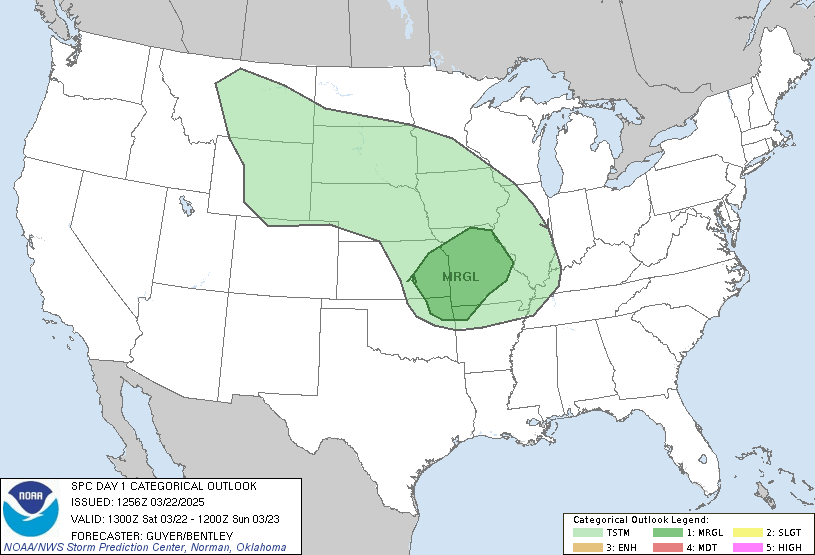
...THERE IS AN ENHANCED RISK OF SEVERE THUNDERSTORMS ACROSS PORTIONS
OF THE NORTHERN AND CENTRAL PLAINS...
...THERE IS A SLIGHT RISK OF SEVERE THUNDERSTORMS ACROSS THE LOWER
MISSISSIPPI VALLEY...
...SUMMARY...
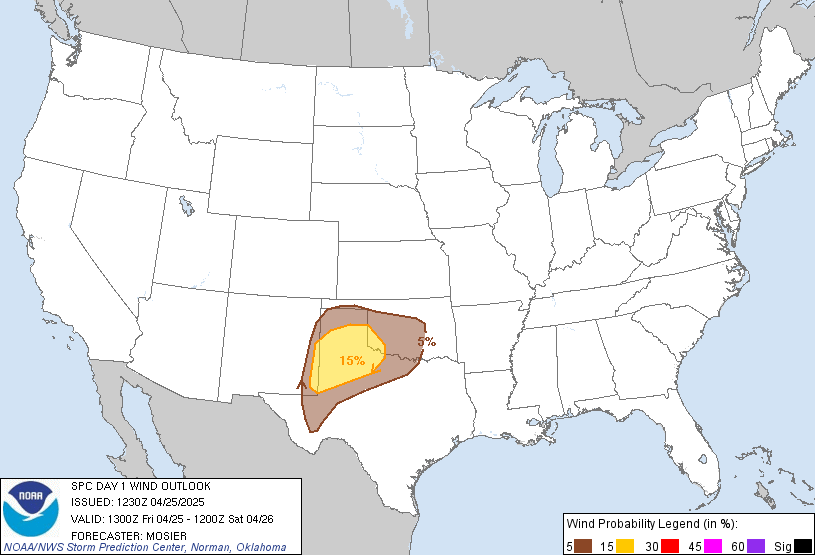
Numerous severe thunderstorms with a potential for 60-80 mph winds
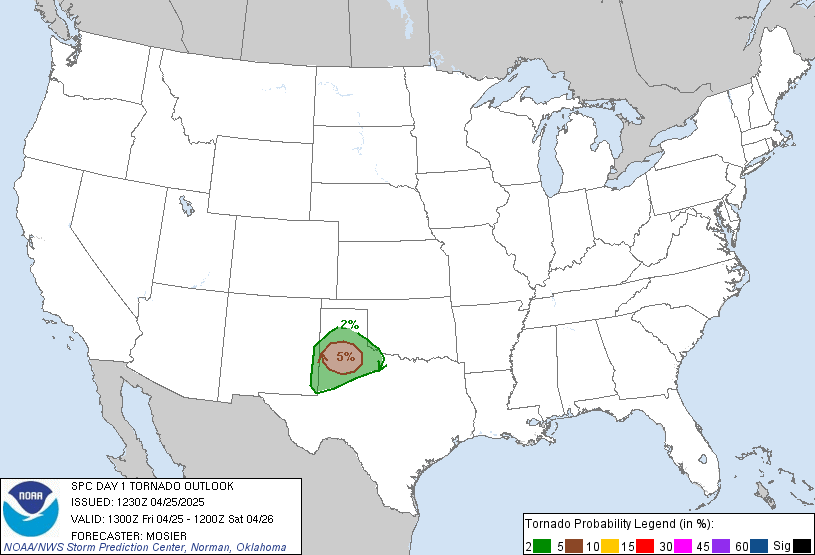
with locally higher gusts, along with tornadoes (some potentially
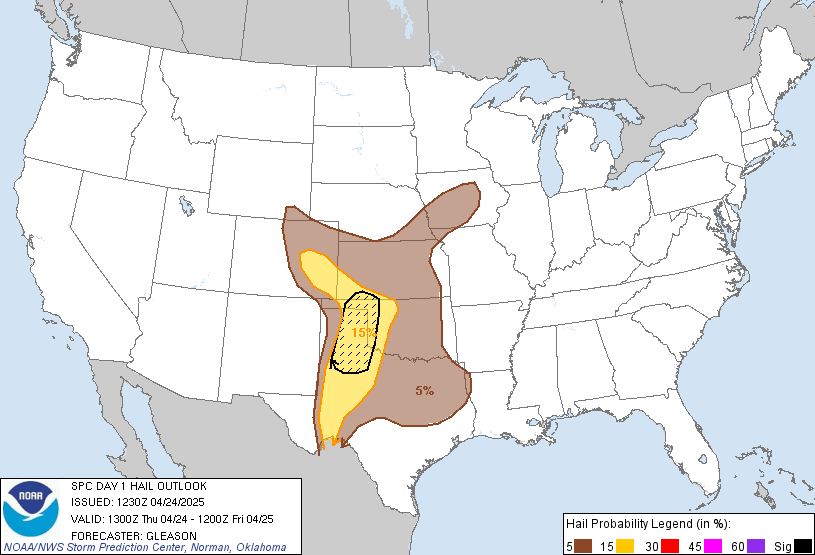
strong), and large to very large hail are expected across the
northern and central Plains this afternoon and tonight. Severe wind
gusts and large hail will also be possible from north-central and
west-central Kansas southwestward into the Texas Panhandle.
...Central and Northern Plains...
Current satellite imagery shows negatively tilted upper troughing
from the Pacific Northwest into the central Rockies, with an
embedded shortwave trough emerging over the northern/central High
Plains. This shortwave is forecast to continue northeastward today,
with associated height falls spreading from the northern/central
High Plains into the northern/central Plains and Upper Midwest.
Recent surface analysis shows a moist airmass across the Plains,
although notable airmass modification has occurred across KS and
western MO from an overnight MCS. Outflow associated with this MCS
currently arcs from south-central KS through extreme northeast OK
and southwest MO into south-central MO. Convective outflow also
exists over south-central NE. These features add to an already
complex surface pattern which features several lows along a wavy
surface trough from north-central MO into southeast CO. A stationary
boundary also extends northeastward from the low over southeast MT
through south/eastern ND and far northwest MN.
General expectation is for the north/central High Plains to eject
over the northern Plains, with the associated large-scale ascent and
convergence along the cold front contributing to thunderstorms
across a large portion of the northern and central Plains. Very
strong buoyancy (i.e. MLCAPE over 2500 J/kg) will be in place across
much of this region, with potential pockets of extreme buoyancy
(i.e. MLCAPE over 4000 J/kg) from eastern SD through eastern
NE/extreme western IA. Thunderstorms are expected to form near the
front/dryline by mid/late afternoon, along the western edge of the
greater buoyancy from the west-central Dakotas southward into
western Nebraska. High LCLs and more southerly deep-layer shear will
favor a linear mode. These linear storms will move eastward into a
more moist and unstable airmass, while shear also strengthens and
becomes more southwesterly, likely resulting in a one or more
fast-moving convective lines. Primary hazard within these lines will
be significant wind gusts (75+ mph), although increasing low-level
southerly/southeasterly flow with eastern extent could also support
embedded tornadoes. Hail is also possible within the stronger
updrafts, particularly earlier in the convective cycle.
A lower confidence, but still noteworthy, tornado risk will be
associated with any more discrete development that occurs within the
warm sector ahead of any convective lines. Primary forecast
uncertainty results from the inherent limited predictability of the
more mesoscale forcing mechanisms responsible for convective
initiation east of the greater large-scale ascent. Environmental
conditions support supercells capable of all hazards, including
strong tornadoes, with any mature convection. Two areas that appear
to have a relatively higher potential for discrete storms are
east-central into northeast ND, and eastern NE into southeast SD and
western IA/southwest MN. Stronger low-level flow will persist across
these areas, resulting in greater warm-air advection with perhaps
the realization of a discrete storm or two.
...Western and central Kansas and Texas and Oklahoma Panhandles...
Persistent southwesterly flow aloft atop a diurnally destabilizing
airmass is expected to support high-based thunderstorms across
southeast CO/northeast NM this afternoon. These storms are then
expected to persist downstream into the more unstable airmass across
southwest KS, the OK Panhandle, and northern TX Panhandle. Large
hail is possible early in the convective cycle but upscale growth
into a more linear bowing segment is anticipated. Given the high
cloud bases and steep low-level lapse rates, strong to severe gusts
are also possible, including the possibility for a few gusts over 75
mph.
...Middle Mississippi Valley/Lower Ohio Valley...
Airmass destabilization is anticipated this afternoon within the
very moist airmass in place over the region. Thunderstorm
development is expected across the region as a weak MCV, currently
over central MO, tracks southeastward into the region. Shear will be
modest, likely limiting storm organization, but strong buoyancy will
support robust updrafts and the potential for damaging gusts. Given
multiple surface boundaries and the presence of an MCV, a
low-probability tornado risk exists as well.
..Mosier/Squitieri.. 06/09/2026
Read more CHECK UPDATE ZOOM GRAPHIC
http://dlvr.it/TSyNgj