Day 1 Convective Outlook
NWS Storm Prediction Center Norman OK
0802 PM CDT Sat Jun 06 2026
Valid 070100Z - 071200Z
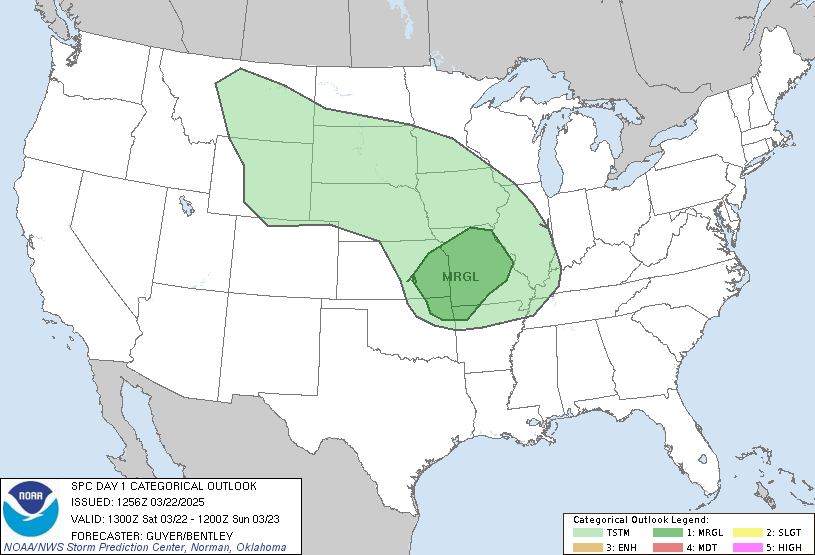
...THERE IS AN ENHANCED RISK OF SEVERE THUNDERSTORMS ACROSS PARTS OF
THE NORTHERN HIGH PLAINS...
...THERE IS A SLIGHT RISK OF SEVERE THUNDERSTORMS ACROSS PARTS OF
THE OHIO VALLEY...MID-ATLANTIC AND SOUTHERN NEW ENGLAND...
...SUMMARY...
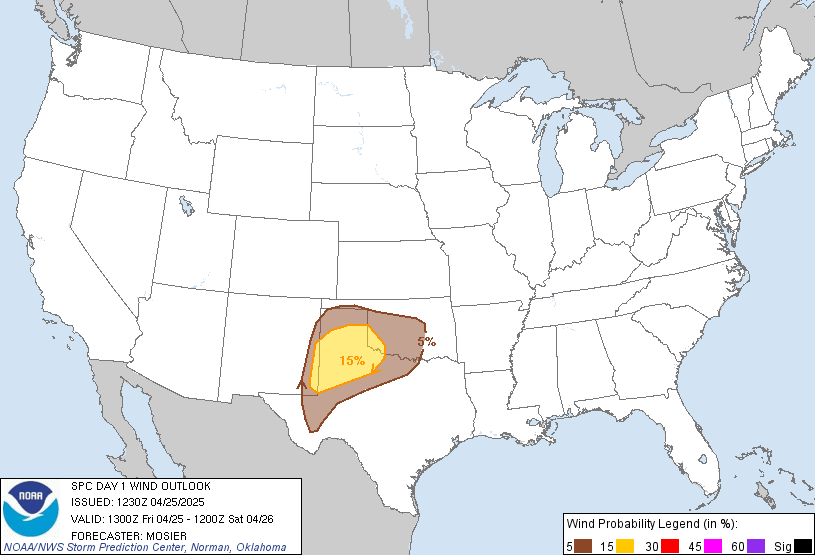
Thunderstorms with severe wind gusts and hail are expected this
evening over parts of southern New England, and from the Ohio Valley
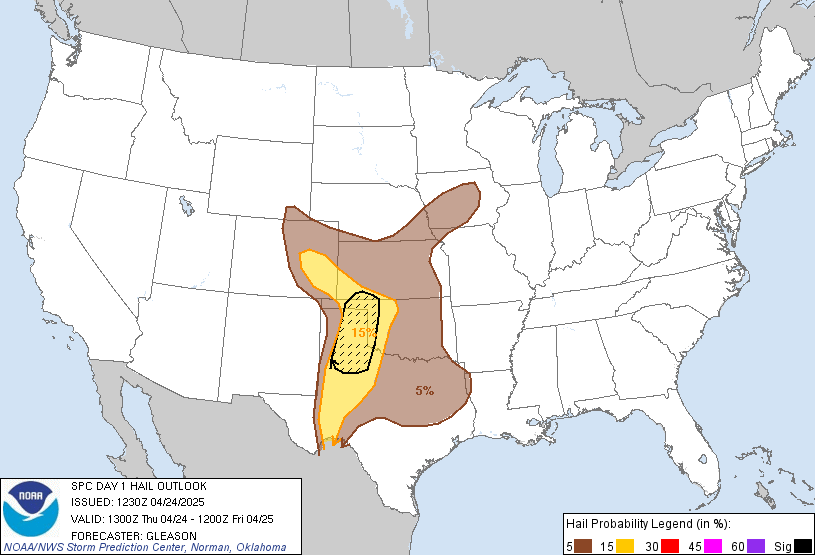
into the northern Mid-Atlantic. Large hail and severe wind gusts
(including gusts exceeding 75 mph) are also expected in the northern
High Plains.
...New England...
A line of strong to severe thunderstorms is ongoing from New Jersey
northeastward into southern New England. This line is being
supported by large-scale ascent associated with a mid-level
shortwave trough moving eastward through the central Appalachians.
Ahead of the line, surface dewpoints across southern New England are
in the lower to mid 60s F, and the RAP is analyzing MUCAPE around
1000 J/kg. The WSR-88D VWPs at both New York and Boston have 0-6 km
shear in the 30 to 35 knot range, with 35 knots of flow 1 km above
the surface. This environment, along with steep low-level lapse
rates, evident on forecast soundings will be favorable for severe
wind gusts as the line moves eastward across southern New England
this evening.
Further north across the remainder of New England, scattered
thunderstorms are ongoing. These storms are located in the vicinity
of an instability maximum, where the RAP has MUCAPE in the 1000 to
1500 J/kg range. In addition, moderate deep-layer shear is present
which should support an isolated threat for severe gusts and hail.
...Southern Great Lakes/Ohio Valley...
The latest water vapor imagery shows west-northwesterly mid-level
flow over the Great Lakes and Ohio Valley. At the surface, a cold
front is located from far northern Indiana eastward to near Lake
Erie. To the south of the front, dewpoints are mostly in the lower
70s F, which is contributing to moderate instability. The RAP has
MLCAPE in the 1500 to 2500 J/kg range. Scattered thunderstorms are
ongoing along and to the south of the instability axis. The
strongest deep-layer shear is analyzed from Ohio into southern
Pennsylvania, which should be the favored corridor for supercell
development. Isolated large hail and severe gusts will be possible
with supercells. Multicells will also be capable of strong to severe
gusts.
Further west into the mid Mississippi Valley, a few strong to severe
storms will be possible near a pocket of moderate instability. Steep
low-level lapse rates will support a potential for isolated severe
gusts. Hail will also be possible.
...Northern High Plains...
Over the northern High Plains, water vapor imagery shows a mid-level
shortwave trough moving northeastward through the flow. Ahead of the
trough, a moist and unstable airmass is located across eastern
Montana and western North Dakota, where surface dewpoints are mostly
in the upper 50s and lower 60s F. Over this area, the RAP has MLCAPE
in the 2500 to 3500 J/kg range. Along the western edge of the
stronger instability, thunderstorms are expected to develop this
evening. The storms will move northeastward across northeastern
Montana and far northwestern North Dakota.
Forecast soundings to the northwest of Williston have 0-6 km shear
of 45 to 50 knots with 700-500 mb lapse rates approaching 9 C/km.
This will support the development of supercells with large hail.
Hailstones greater than 2 inches in diameter will be possible with
the more dominant storms. In addition, low-level lapse rates will be
very steep supporting severe wind gusts. A few gusts above 75 mph
will be possible, especially if a cold pool can organize.
...Southern Plains/Ark-La-Tex...
A mid-level shortwave trough is currently evident on water vapor
imagery over northwest Texas, with a moist and unstable airmass in
place from central and north Texas into southern Oklahoma. Scattered
thunderstorms are ongoing along the western edge of the stronger
instability along the I-35 corridor from the northern Texas Hill
Country into the Dallas/Fort Worth Metro. Steep lapse rates and
moderate deep-layer shear will continue to support an isolated
wind-damage and hail threat for a couple more hours this evening.
Further east into the Ark-La-Tex, scattered storms are ongoing from
far eastern Oklahoma into far western Arkansas. These storms are
located along the northern edge of moderate instability, where the
RAP has MLCAPE around 2000 J/kg. Forecast soundings near Fort Smith
early this evening have 0-3 km storm-relative helicity around 200
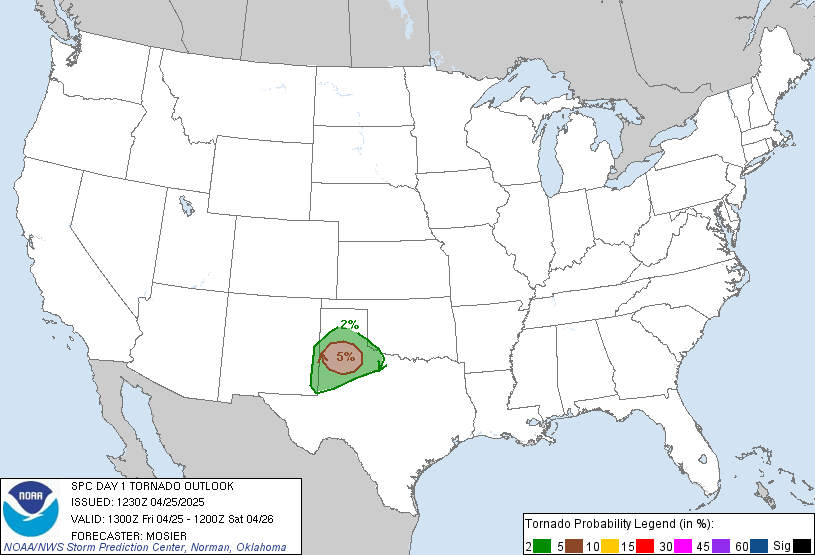
m2/s2 suggesting an isolated tornado threat will exist. The tornado
threat should persist for a couple more hours.
..Broyles.. 06/07/2026
Read more CHECK UPDATE ZOOM GRAPHIC
http://dlvr.it/TSw3rX