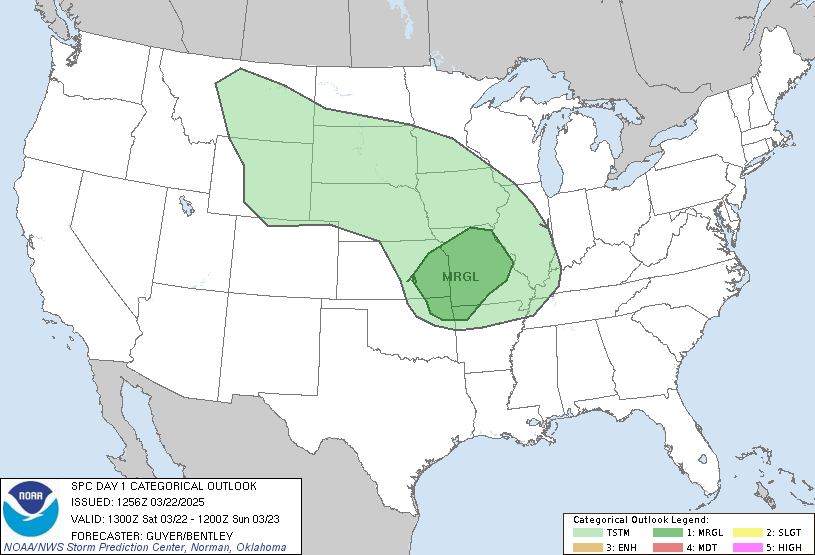
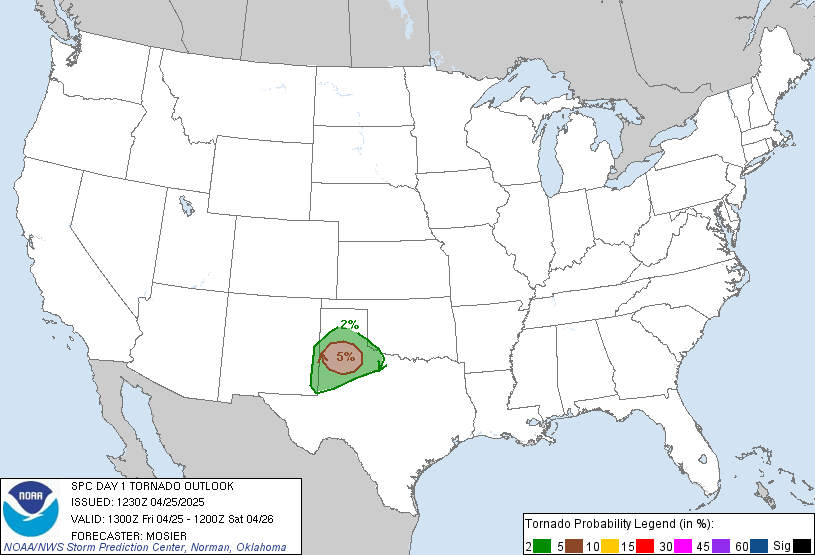
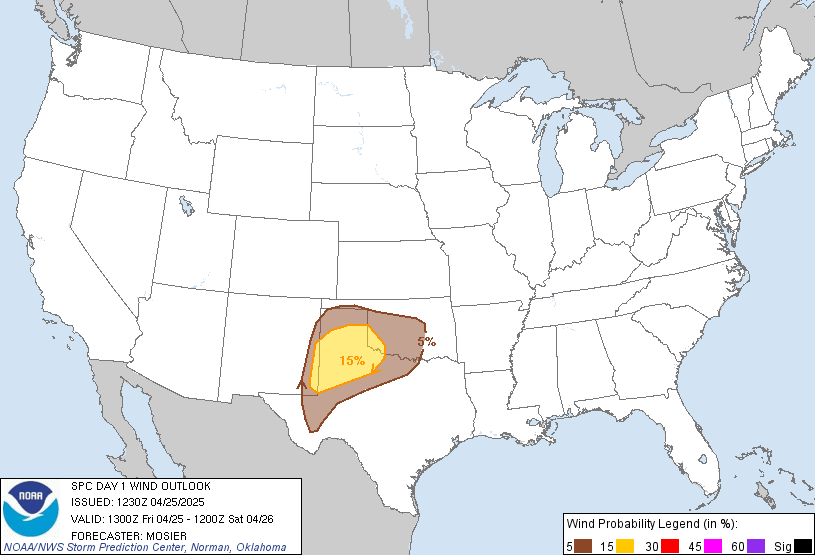
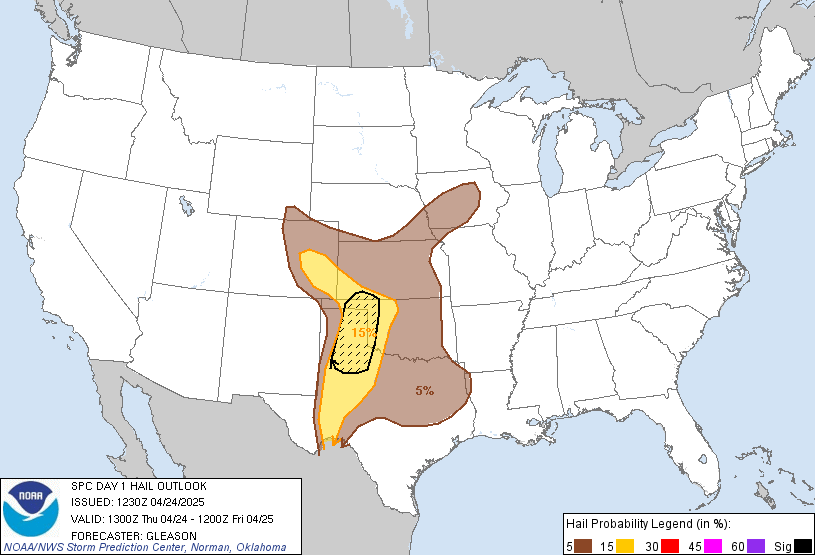
Day 1 Convective Outlook
NWS Storm Prediction Center Norman OK
0100 AM CDT Thu Jun 25 2026
Valid 251200Z - 261200Z
...THERE IS A SLIGHT RISK OF SEVERE THUNDERSTORMS THIS AFTERNOON
INTO TONIGHT ACROSS PARTS OF THE SOUTHERN AND CENTRAL GREAT
PLAINS...
...SUMMARY...
One or two organizing clusters of storms, with potential to produce
strong to severe wind gusts, are possible across parts of the Texas
South Plains through central Great Plains late this afternoon into
tonight. Isolated strong storm development preceding this activity
across parts of north central Oklahoma into south central Kansas may
pose a risk for a couple of tornadoes by early this evening.
...Discussion...
The westerlies are undergoing amplification across the mid-latitude
Pacific. Later today into tonight, models indicate that this will
include digging large-scale mid-level troughing on its leading edge,
across and inland of the Pacific Northwest coast. Downstream, it
appears that generally zonal flow will prevail across the northern
and central tier of the U.S., to the north of ridging in the
subtropical latitudes. Within this regime, mid-level troughing,
accompanied by an area of modest height falls within otherwise
rising heights, is forecast to turn eastward across the lower Great
Lakes vicinity. Upstream, initially stronger mid-level height falls
accompanying a short wave perturbation, and perhaps a notable
embedded mesoscale convective vortex, may be in the process of
overspreading the central Great Plains at the outset of the period,
before continuing toward the lower Missouri Valley, amidst weak to
modest larger-scale height rises late this afternoon through
tonight.
In lower levels, a broad weak surface low is forecast to migrate
across the lower Great Lakes, with a an ill-defined trailing influx
of cooler/drier air advancing a bit farther southward through the
central Great Plains, and southeast of the Upper Midwest through the
Great Lakes and adjacent portions of the Ohio Valley. It appears
that surface troughing will deepen through the day to the lee of the
southern Rockies, as strong heating occurs beneath a remnant plume
of very warm elevated mixed-layer air across the southern Great
Plains. Near the northern/northeastern periphery of this air mass,
a zone of strong differential heating may develop by late afternoon,
northeast of the Raton ridge into northern Oklahoma. This boundary
might be augmented by outflow from a cluster of storms now evolving
across northeastern Colorado into western Kansas. It appears that
this boundary may retreat northward into portions of southern Kansas
and Missouri tonight.
...Parts of southern/central Great Plains...
The potential convective evolution for today remains unclear, and
severe weather potential will considerably be impacted by
sub-synoptic developments, which remain unclear. This includes the
subsequent evolution of the cluster of storms now propagating into
northwestern Kansas, and another forming across the Texas Panhandle
vicinity. However, guidance generally suggests that low-level
convergence and destabilization within the lee surface trough across
the Panhandle vicinity into Texas South Plains may provide support
for widespread thunderstorm development by early this evening. And
the boundary across the central Great Plans, reinforced by early day
outflow and subsequent differential heating, may eventually become a
focus for increasing thunderstorm development this evening into the
overnight hours.
A deeply mixed boundary layer across the Panhandle/South Plains
vicinity may become unstable enough to support the risk for large
hail, in addition to damaging wind gusts late this afternoon into
evening.
Low-level convergence/warm advection along the zone of differential
surface heating might promote at least isolated supercell
development somewhere across north central Oklahoma into south
central Kansas, where a convectively augmented belt of westerly
mid-level flow may contribute to strong shear. If this occurs, this
may be accompanied by a period of increasing potential for a tornado
or two by early evening, near the nose of a strengthening southerly
850 mb jet, before evolving into an upscale growing cluster with
strong surface gusts becoming the primary potential hazard
overnight.
...Lower Great Lakes...
Convection allowing model output is still not providing a clear
signal for more than rather isolated pre-frontal strong to severe
thunderstorm development. However, strengthening westerly flow in
the 700-500 mb layer could become sufficient to support organized
convective development, including supercells, with sufficient
destabilization. Depending on model trends, it is still possible
that probabilities could be increased in later outlooks for this
period.
...Parts of central and southern Wyoming...
Latest convection allowing guidance suggests that thermodynamic
profiles by this afternoon could become conducive to the evolution
of an organizing cluster of storms with potential to produce strong
to severe surface gusts, aided by forcing for ascent associated with
a short wave perturbation emerging from the northern intermountain
region.
..Kerr/Chalmers.. 06/25/2026
Read more CHECK UPDATE ZOOM GRAPHIC
http://dlvr.it/TTCP98