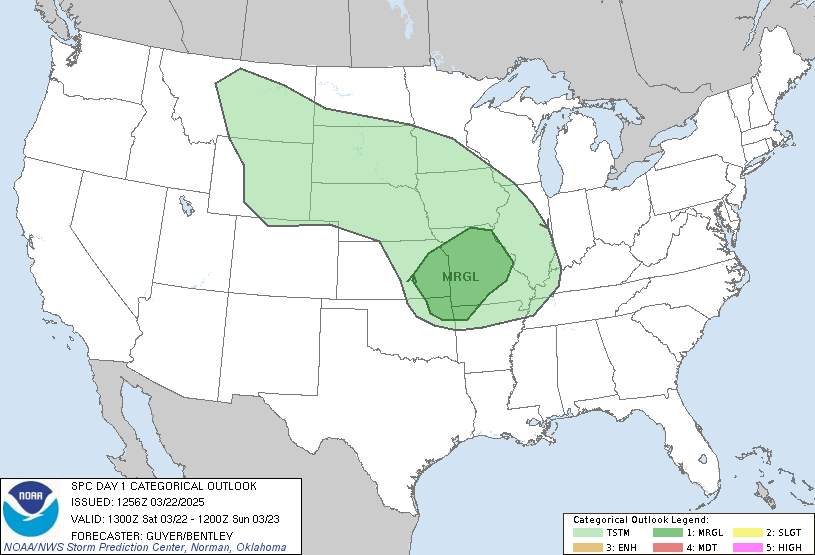
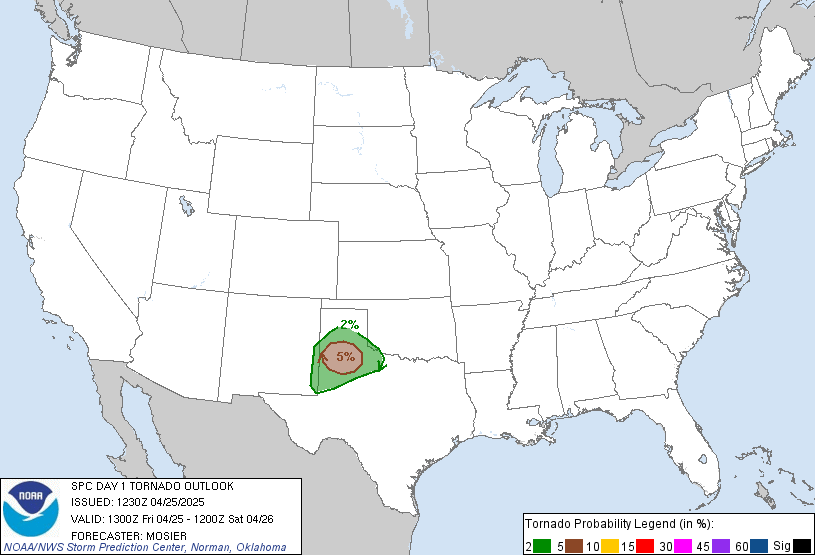
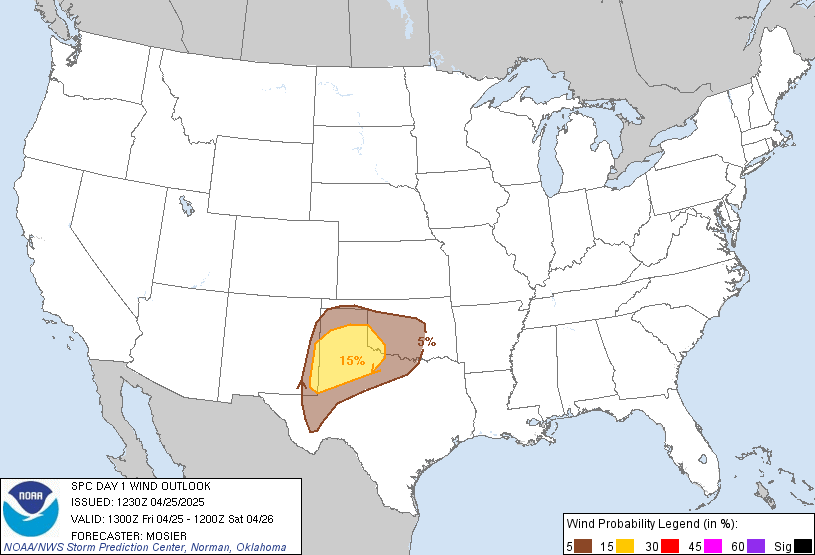
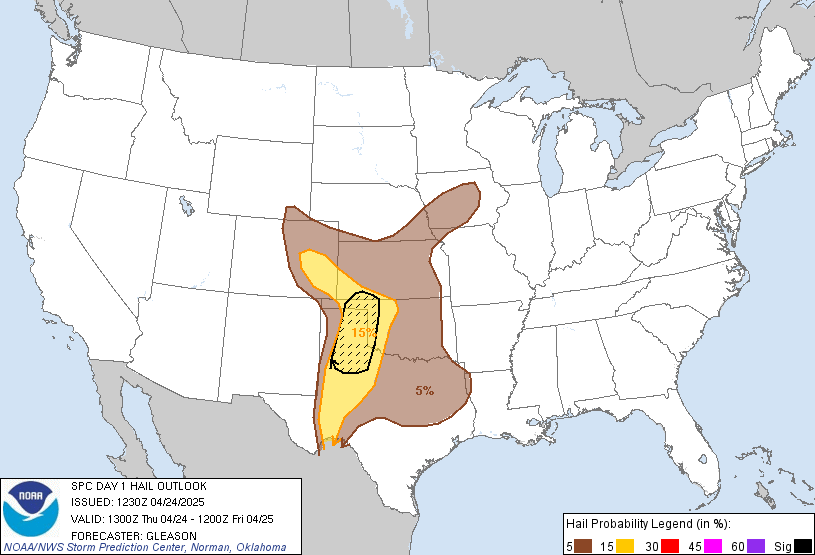
Day 1 Convective Outlook CORR 1
NWS Storm Prediction Center Norman OK
1203 PM CDT Fri Apr 17 2026
Valid 171630Z - 181200Z
...THERE IS A MODERATE RISK OF SEVERE THUNDERSTORMS FROM FAR
NORTHWEST OKLAHOMA THROUGH CENTRAL AND EASTERN KANSAS INTO
WEST-CENTRAL MISSOURI...
CORRECTED FOR ORIENTATION OF THE 45% HAIL PROBABILITIES
...SUMMARY...
Numerous severe thunderstorms are likely this afternoon into tonight
across parts of the Upper Midwest southward across the lower
Missouri Valley and central/southern Great Plains. Initially this
may be accompanied by a risk for large to giant hail and a few
strong tornadoes, before severe wind gusts of 60 to 90 mph become
the most prominent hazard by this evening.
...Synopsis...
Recent surface analysis places a low over south-central MN, with a
cold front extending southwestward to another low over central KS. A
warm front also extends southwestward from the MN low through far
southwest MN and far northern IL into central IN. This warm front is
demarcated well by the 56 deg F isodrosotherm. Farther south, a
dryline extends from the triple point KS low back southwestward
through the TX Panhandle and into far southeast NM. A broad, moist
warm sector exists to the east of the cold front and dryline,
characterized largely by dewpoints in the low to mid 60s.
A well-defined shortwave trough is apparent on satellite imagery,
extending from southern Saskatchewan back southwestward into the
eastern Great Basin. This wave is forecast to continue eastward,
with a attendant increase in the mid-level flow across much of the
Plains and Upper/Mid MS Valley. The cold front will surge
eastward/southeastward in response to this wave as well, interacting
with the warm sector to support numerous strong to severe
thunderstorms from parts of the Upper Midwest southward across the
lower Missouri Valley into southern Plains.
...Upper/Mid MS Valley...
Moderate to strong low-level moisture advection is expected across
the Upper MS Valley today as the surface low mentioned in the
synopsis progresses northeastward, with an attendant northward shift
of the warm front as well. The risk across this region may evolve in
several phases, beginning with the elevated thunderstorms currently
ongoing across northwest WI. This storms will likely continue
northeastward, posing a risk for severe hail and isolated damaging
gusts. Additional development is possible northwest of this activity
along the occluded front, with some hail possible here as well.
Farther south, the northeastward advecting low-level moisture
coupled with strong heating and steep lapse rates will result in a
strongly unstable airmass along and just south of the warm front by
the early afternoon. Storm initiation is anticipated within this
open warm sector by early afternoon, forced by a mix of warm-air
advection, low-level confluence, and subtly increasing large-scale
ascent. This activity should be ahead of the front and initially
discrete. The overall parameter space will be characterized by
strong to very strong buoyancy, moderate deep-layer vertical shear,
and strong low-level helicity. Supercells capable of all hazards are
expected, including large to very large (i.e. 3"+ hail), strong to
intense tornadoes, and severe wind gusts. Storm interactions are
expected to strongly influence the tornado risk, with the initially
discrete mode likely becoming messy quickly.
Farther west, other storms are likely to evolve quickly along the
front, developing into a band of severe thunderstorms that will push
east coincident with the front. Damaging wind gusts will tend to
become more prevalent during the evening with linear storm modes.
Some tornado risk may continue into the evening as maturing bands of
storms yield a threat for bowing segments and embedded mesovortices,
before this activity gradually diminishes late as it moves east into
IN/Lower MI late.
...KS/OK/MO...
A very unstable airmass is expected to develop along and ahead of
the triple point over south-central KS an associated cold front and
dryline. Strong low-level convergence will likely lead to initial
storm development near the triple point. This initial activity will
be supercellular and capable of very large to giant hail (over
3-3.5" in diameter). Highest coverage of very large hail is expected
over from far northwest OK into south-central KS. Strong downdrafts
(60 to 80 mph) are possible as well. With a largely
boundary-parallel orientation to the deep-layer shear, the tornado
risk appears relatively lower. However, given the supercell mode and
potential interactions with outflow, a low-probability tornado risk
remains. A more north-south configuration to the dryline supports a
conditional tornado risk into far northwest TX.
With time, upscale growth and the development of a
forward-propagating MCS is anticipated across central and eastern
KS. Very strong gusts (80+ mph) are possible with this MCS.
Additionally, some QLCS tornado risk will exist within this line as
long as it stays ahead of the surging cold front. The front will
continue sweeping southeastward, with storms along this boundary
yielding a risk for wind/hail.
..Mosier/Chalmers.. 04/17/2026
Read more CHECK UPDATE ZOOM GRAPHIC
http://dlvr.it/TS5KX9