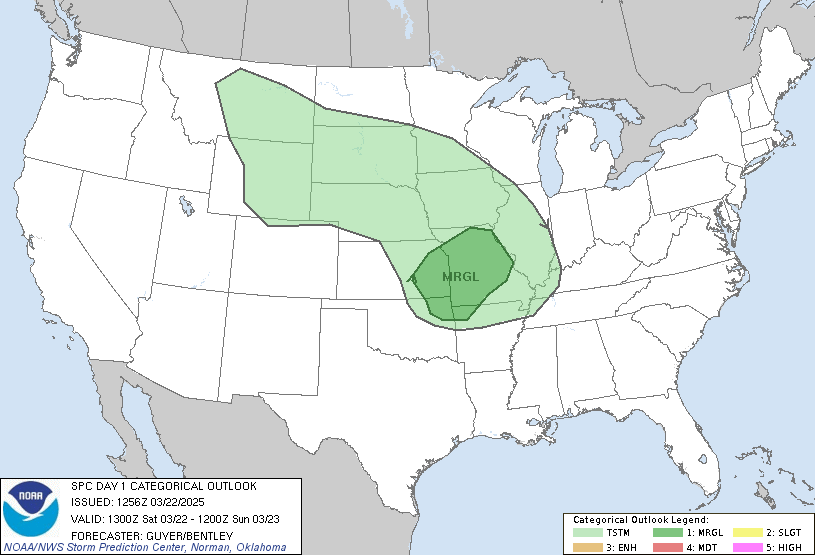
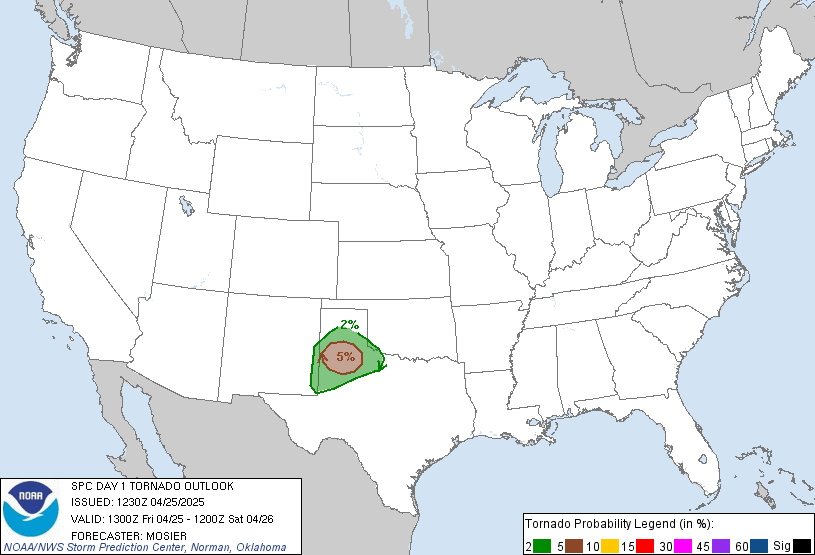
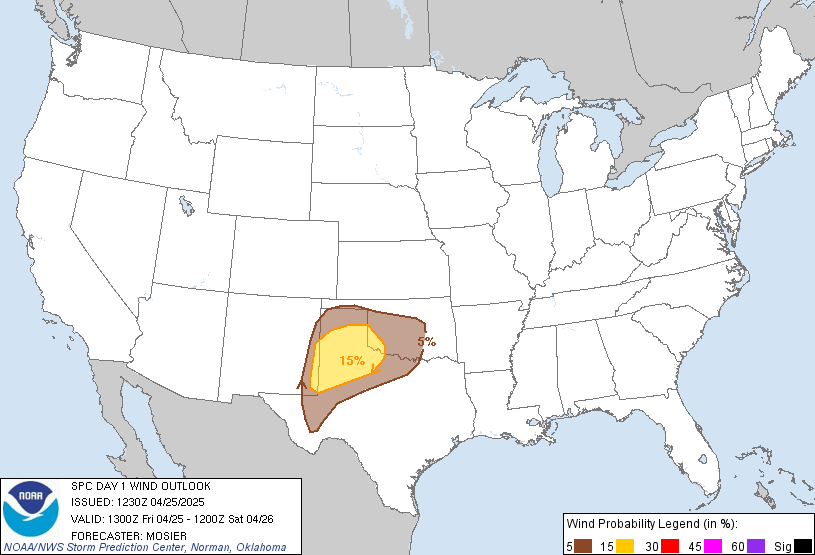
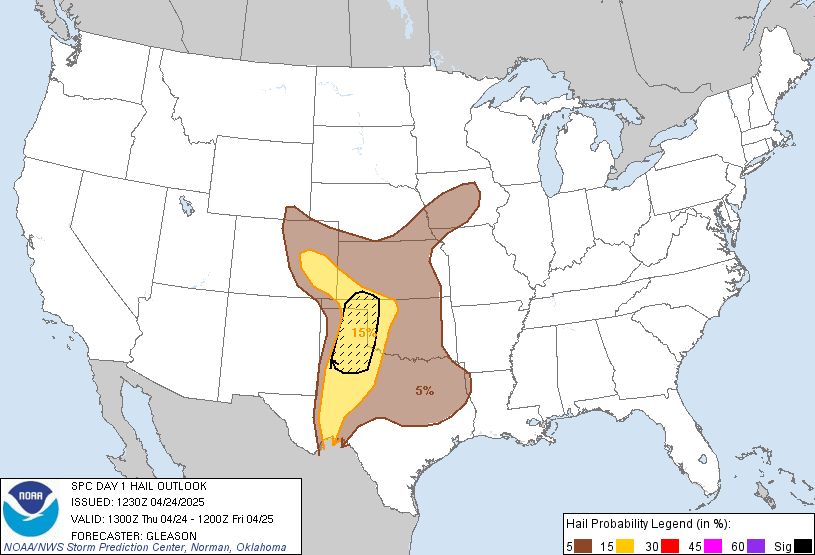
Day 1 Convective Outlook
NWS Storm Prediction Center Norman OK
0300 PM CDT Thu Apr 16 2026
Valid 162000Z - 171200Z
...THERE IS A SLIGHT RISK OF SEVERE THUNDERSTORMS ACROSS NEW YORK
INTO SOUTHERN VERMONT...AND THE OZARKS INTO THE MID-SOUTH...
...SUMMARY...
Scattered severe thunderstorms are possible this afternoon over New
York into southern Vermont with damaging gusts and perhaps a tornado
or two the primary threats. Very large hail and severe gusts are
possible with the stronger storms over the Ozarks into the
Mid-South.
...20Z Update...
The SLGT in the Ozarks/Mid-South was expanded northward into central
MO, where an isolated supercell with a risk of very large hail and
damaging gusts has emerged along the northern periphery of a remnant
cold pool. Farther south within Severe Thunderstorm Watch 127,
several discrete/splitting supercells continue to pose a risk of
very large hail (recent report of 2.75 inches) and locally damaging
wind gusts. With time, this activity may congeal into a loosely
organized cluster, with an increasing risk of damaging wind gusts.
The MRGL risk was also expanded slightly westward into southwest OK,
where boundary-layer cumulus is gradually deepening. Any isolated
storms that can form here will pose a risk of large to very large
hail and severe downbursts. Finally, the MRGL was expanded slightly
westward in southwest TX toward Fort Stockton. While convective
initiation is still in question here, deepening boundary-layer
cumulus along the higher terrain could result in an isolated storm
or two, with a risk of very large hail.
..Weinman.. 04/16/2026
.PREV DISCUSSION... /ISSUED 1124 AM CDT Thu Apr 16 2026/
...Ozark Plateau into the Mid-South...
Recent visible satellite imagery shows some ACCAS across
south-central MO, indicative of low/mid-level warm advection amid
the steep lapse rate environment in place. These steep lapse rates
are forecast to continue spread eastward, while low-level moisture
advection brings low 60s dewpoints northeastward into the region as
well. This will result in a moderate to strongly buoyant airmass
(i.e. MLCAPE from 1500 to 2000 J/kg) by the early afternoon.
Additionally, moderate mid to high level flow will remain in place,
resulting in long hodographs and overall environmental conditions
that are very favorable for supercells capable of large to very
large hail. Latest guidance continues the earlier trends of
developing storms in this area, which match observational
expectations as well. Large to very large hail (1 to 3 inches in
diameter) is possible with any updrafts that mature into supercells.
Low-level flow is weak, keeping tornado probability low but none
zero. Given the modest pocket of mid-level dry air present,
supercells will likely become outflow dominant with time,
supporting the potential for damaging gusts across the region
(particular eastern areas) as well.
...NY/VT/NH southeastward into the central Appalachians...
Recent surface analysis places a low over the eastern
Ontario/southern Quebec border vicinity, with modest surface
troughing extending southeastward from this low across central Lower
MI. Airmass across much of NY is characterized by dewpoints in the
low 60s. Dewpoints should stay in the low 60s throughout the day
despite modest mixing amid diurnal heating. This should result in
airmass destabilization ahead of the modest surface trough, with a
general increase in large-scale ascent beginning during the
afternoon as well. Little to no convective inhibition is
anticipated, supporting the potential for more cellular development
over the warm sector initially, before a more expansive convective
line develops along the eastward-progressing surface trough. Ample
mid to high-level flow will favor storm organization, including a
risk for large hail and a tornado with the more intense discrete
cells. The wind risk will tend to focus with linear structures that
evolve over time. An isolated threat for wind damage and perhaps
hail will extend southward into PA/WV and the Cumberland Plateau,
where a few stronger storms may yield those hazards.
...Edwards Plateau into the TX Big Country and western north TX...
A strongly buoyant and weakly capped airmass is expected to develop
along the dryline extending southwestward from western OK through
the Edwards Plateau. Although neutral to weak shortwave ridging is
expected throughout much of the morning into the late afternoon,
some limited ascent (associated with a weak shortwave trough moving
out of northern Mexico) may begin to spread across the dryline by
early evening. This combined with dryline circulations may be enough
to initiate isolated to widely scattered thunderstorms. Low-level
flow will be weak, but moderate to strong westerly flow aloft will
result in wind profiles very favorable for supercells capable of
large to very large hail. Any storms that develop should weaken
quickly with the onset of nocturnal cooling.
Read more CHECK UPDATE ZOOM GRAPHIC
http://dlvr.it/TS4WxV