Day 1 Convective Outlook
NWS Storm Prediction Center Norman OK
1130 AM CDT Wed Apr 15 2026
Valid 151630Z - 161200Z
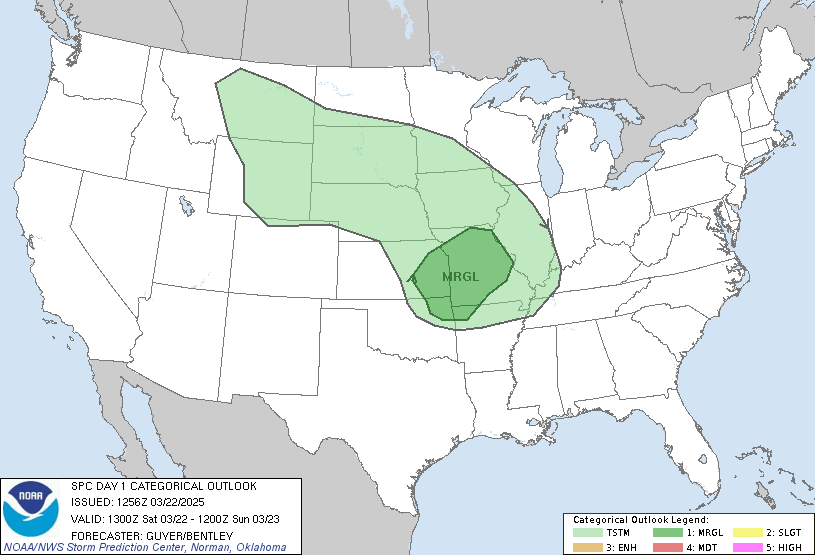
...THERE IS A SLIGHT RISK OF SEVERE THUNDERSTORMS ACROSS PARTS OF
THE SOUTHERN/CENTRAL PLAINS INTO THE MIDWEST/OHIO VALLEY AND
SOUTHERN GREAT LAKES...
...SUMMARY...
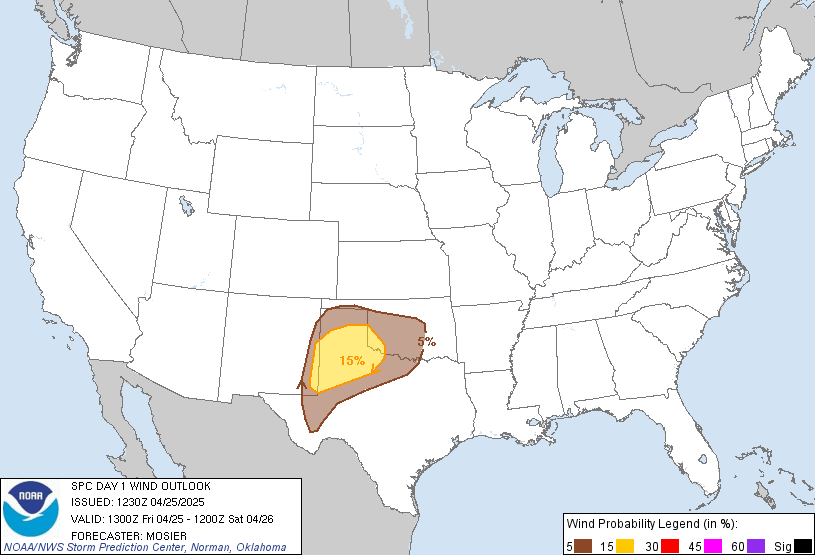
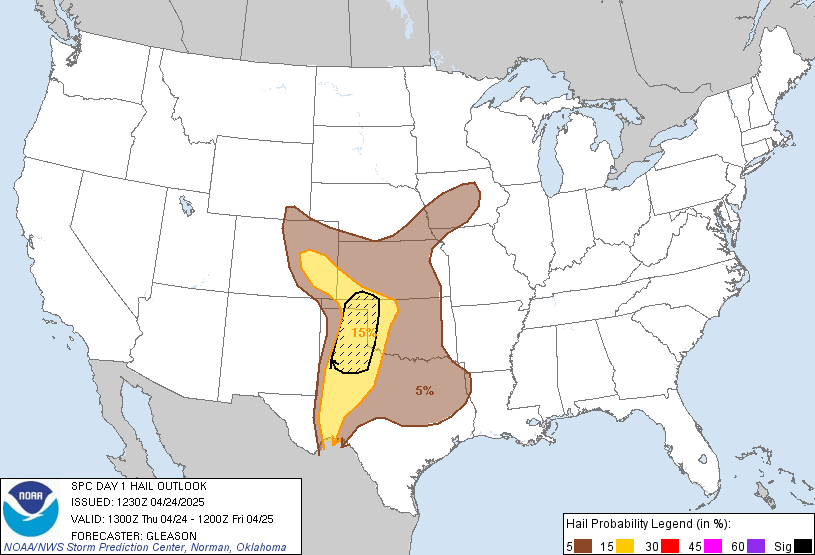
Severe thunderstorms posing a risk for large to very large hail,
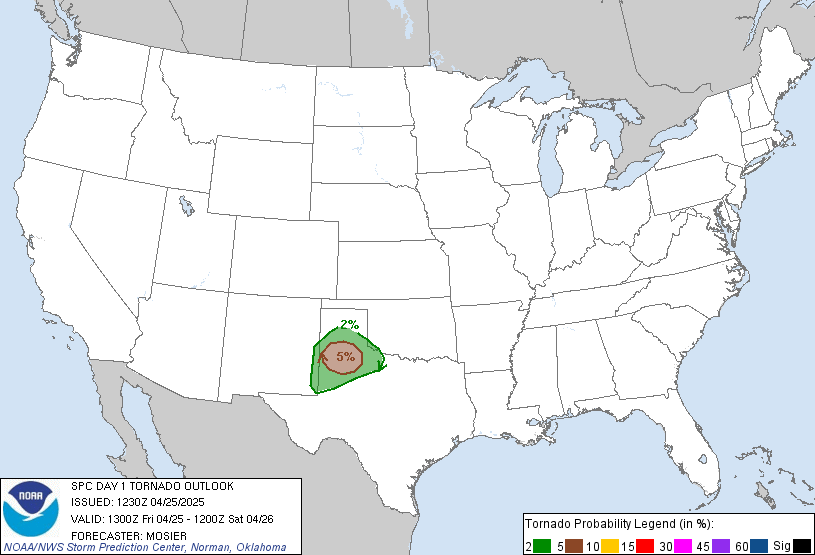
damaging winds, and perhaps a few tornadoes will be possible across
parts of the southern/central Plains into the Midwest/Ohio Valley
and southern Great Lakes this afternoon and evening.
...Synopsis...
Severe potential across the broad warm sector will be complicated by
ongoing thunderstorms/MCVs and associated cloud cover. A neutral to
positively tilted upper trough will eject northeastward across the
southern/central Plains today, with a broad zone of enhanced
mid-level southwesterly winds extending over much of TX/OK into the
Midwest/OH Valley and Great Lakes. At the surface, a weak low over
southeast NE late this morning is forecast to develop slowly
northeastward across IA through the afternoon and evening, with a
quasi-stationary front extending northeastward from this low towards
southern WI/Lower MI. A dryline extends southward across KS/OK into
west TX. Multiple MCVs related to ongoing/earlier convection are
also noted in recent visible satellite/radar imagery, and these
features may aid additional convective development this afternoon.
...Iowa into Missouri...
Forcing for ascent associated with the ejecting upper trough will
overspread the front draped across IA this afternoon. Ongoing
supercell in western IA and cloudiness near the front late this
morning cast some uncertainty on the degree of destabilization that
will occur this afternoon, and the overall intensity of convection.
Still, expectations are for additional robust thunderstorms to
eventually develop by 19-21Z along/near the front in IA, with steep
mid-level lapse rates noted on the observed 12Z TOP sounding
supporting moderate to locally strong MLCAPE even if
clouds/precipitation hinder daytime heating to some extent. Various
NAM/RAP forecast soundings show elongated/nearly straight hodographs
at mid/upper levels and 50+ kt of deep-layer shear, which will be
favorable for upper-level/anvil venting and hail production with any
supercells that form. Large to very large hail will be a concern
with initially discrete convection. But, some tendency for
clustering and movement north of the surface front casts
considerable uncertainty on the wind/tornado potential. Even so,
some chance for a few tornadoes and scattered damaging winds may
exist along/south of the front across IA into MO with any convection
that can develop east of the dryline.
...Southern Plains into the Ozarks and Mid Mississippi Valley...
A seasonably moist low-level airmass remains in place across the
southern Plains into the Ozarks and mid MS Valley, with observed 12Z
soundings from FWD/OUN/SGF indicating mean mixing ratios ranging
12-13.6 g/kg. However, even with steep mid-level lapse rates noted
across TX/OK, profiles are fairly saturated at mid/upper levels, and
plentiful cloud cover is present in recent visible satellite imagery
across these regions. It still appears likely that surface-based
thunderstorms will develop this afternoon (around 19-21Z) along/east
of the dryline as MLCIN gradually erodes ahead of the ejecting upper
trough. But, overall evolution remains somewhat unclear, with
potential for messy storm modes/interactions fairly early in the
convective life cycle given a large degree of boundary-parallel flow
in low/mid levels. Initial supercells should pose a threat for
mainly large to very large hail (isolated 2+ inches in diameter),
before clustering and an increase in damaging wind potential occurs.
The tornado threat is less clear, as stronger low-level flow will
tend to remain focused farther north into the Midwest. Still,
sufficient low-level shear should exist this afternoon and evening
to support a threat for a few tornadoes with both supercells and
embedded within clusters.
...Midwest/Ohio Valley into Western Pennsylvania...
An MCV evident over eastern IL/western IN will continue to track
eastward into northern IN and eventually OH this afternoon and
evening. Ongoing thunderstorms associated with this MCV have
remained sub-severe through much of the morning. But, gradual
destabilization of the already moist low-level airmass downstream
should support some uptick in convective coverage and intensity
across the OH Valley by mid to late afternoon. Localized enhancement
to the west-southwesterly low-level winds should focus across parts
of northern OH and vicinity, where somewhat greater low-level shear
and tornado potential may exist. Strong deep-layer shear will easily
support organized convection, including the potential for supercells
with a threat for large hail, damaging winds, and perhaps a couple
of tornadoes. Additional thunderstorms may eventually develop
eastward from the mid MS Valley into IL/IN in association with
another MCV. Large hail, damaging winds, and a tornado or two may
also occur with this activity, if it develops.
..Gleason/Squitieri.. 04/15/2026
Read more CHECK UPDATE ZOOM GRAPHIC
http://dlvr.it/TS3TgD