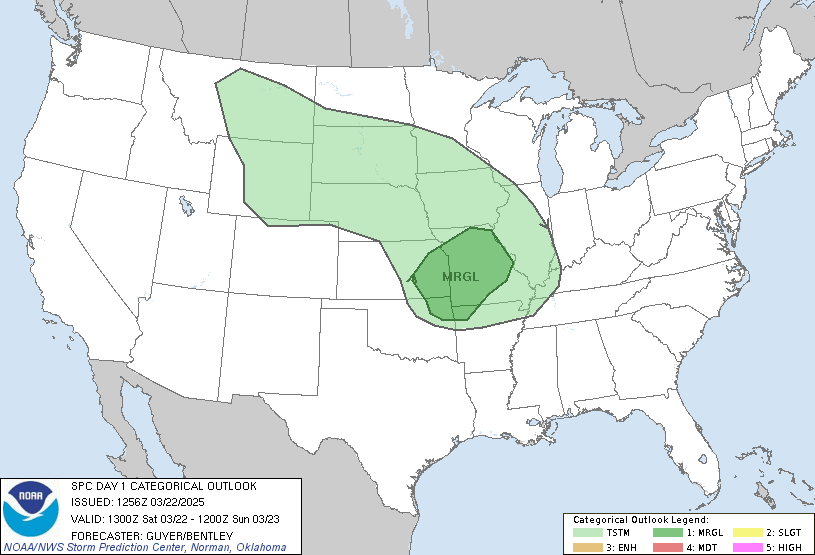
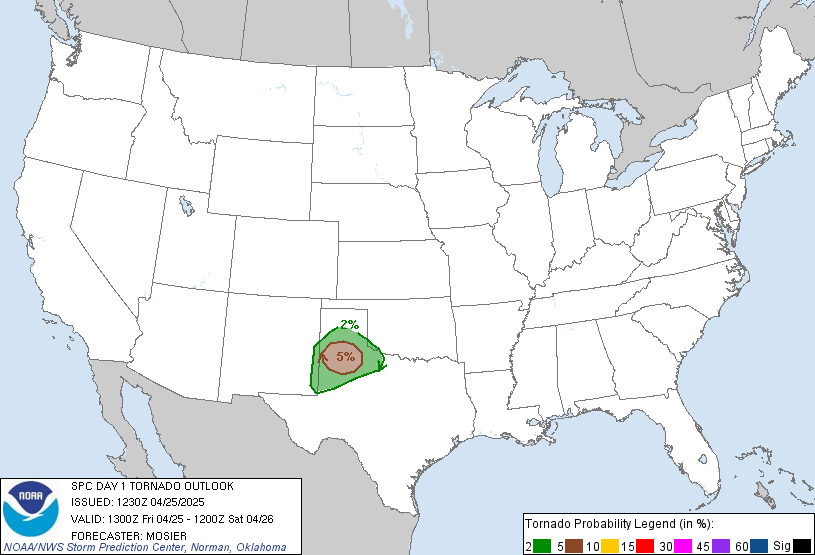
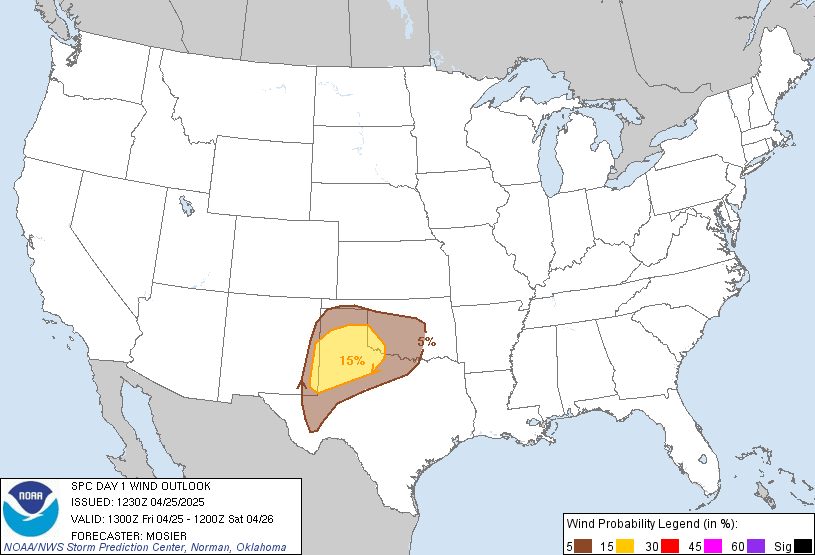
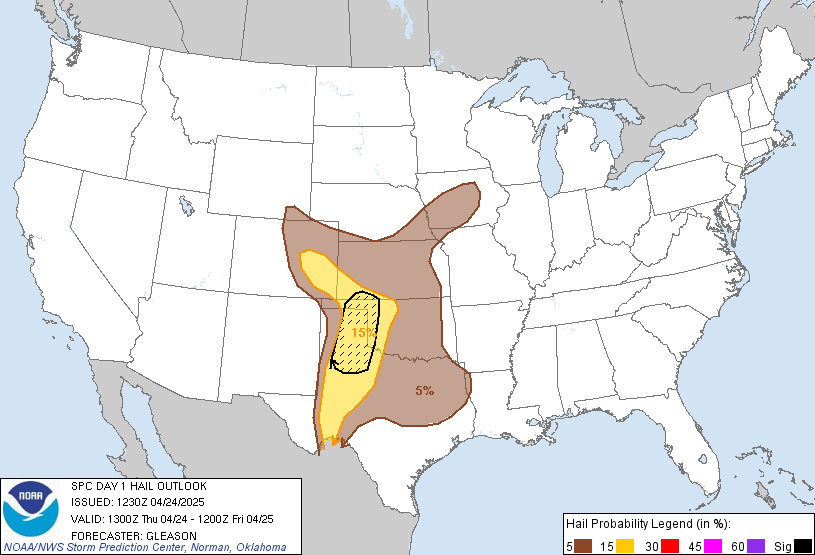
Day 1 Convective Outlook
NWS Storm Prediction Center Norman OK
1253 AM CDT Wed Apr 15 2026
Valid 151200Z - 161200Z
...THERE IS A SLIGHT RISK OF SEVERE THUNDERSTORMS ACROSS THE
SOUTHERN PLAINS...MIDWEST...AND INTO THE GREAT LAKES...
...SUMMARY...
Severe thunderstorms posing a risk for large hail, strong wind
gusts, and a couple of tornadoes will be possible across portions of
the southern Plains toward the Great Lakes this afternoon and
evening.
...Synopsis...
A migratory upper-level wave is evident in water-vapor imagery over
northern Mexico. This feature will lift northeastward into the
Plains through the day, resulting in the eastward progression of a
modest surface cyclone from the central High Plains into eastern NE
by late afternoon. A broad, uncapped, and moderately sheared warm
sector will be in place from the southern Plains into the mid-MS
Valley and eastward into the Great Lakes/OH Valley. Strong to severe
thunderstorm development appears probable across much of this warm
sector, whether induced by ascent ahead of the primary upper wave or
by localized mesoscale boundaries.
...Iowa and northern Missouri...
Thunderstorm development appears likely by late afternoon from
central IA into northern MO in the vicinity of the surface low.
Stronger mid-level height falls compared to previous days lends
higher confidence in thunderstorm development, and 50-60 knot 500 mb
flow overspreading much of the warm sector will support organized
convection, including the potential for splitting supercells capable
of very large hail and tornadoes across IA and northern MO. A
focused zone of higher tornado potential may emerge roughly along
the I-80 corridor where backed low-level winds along the effective
warm front will locally augment SRH and could support a strong
tornado. HREF/REFS guidance both show the strongest UH signals
across this zone, warranting higher (5%) tornado probabilities.
...Ozarks into Oklahoma and north Texas...
Further south, initially discrete cells are anticipated along the
dryline from southeast KS into OK and north TX by mid-afternoon.
Despite somewhat higher confidence in storm development compared to
previous days, mean flow vectors along the boundary may promote
clustering and upscale growth within a few hours after initiation.
This scenario appears to be reflected in recent HREF/REFS guidance
in the form of numerous, but weak, UH streaks, as well as in
deterministic CAM solutions that depict one or more convective bands
emerging by early evening. Additionally, guidance hints at the
potential for morning convection across parts of OK and the Ozark
Plateau. It remains unclear what influence - if any- this activity
will have on the southern Plains warm sector or if any outflow
boundaries can emerge and focus a higher severe threat along
mesoscale corridors. Given these uncertainties, all severe
probabilities were expanded to account for the fairly wide envelope
of potential outcomes, most of which will likely feature the
potential for severe hail, wind, and tornadoes.
...Great Lakes into New England...
The combination of low to mid-60s dewpoints and the eastward
advection of an EML will support MLCAPE values upwards of 1000-1500
J/kg across much of the Great Lakes region with gradually
diminishing buoyancy with eastward extent towards the New England
coast. Aloft, 40-50 knot westerly mid-level winds will remain in
place within the crest of a modest ridge, establishing a zonal
corridor of a buoyant and moderately sheared environment. It appears
likely that multiple outflow boundaries and/or mid-level
perturbations associated with upstream MCSs across MI, AR, and IA
will likely reside within the warm sector by peak heating.
Thunderstorm development along or in the vicinity of these features
will support multiple corridors of strong to severe convection. This
scenario is depicted by most recent CAMs, which show multiple
convection bands traversing the warm sector through early evening.
However, exactly where these bands will become established (and
where corridors of higher severe potential will emerge) remains
uncertain given variance in recent guidance.
..Moore/Wendt.. 04/15/2026
Read more CHECK UPDATE ZOOM GRAPHIC
http://dlvr.it/TS2mwR