Day 1 Convective Outlook
NWS Storm Prediction Center Norman OK
1130 AM CDT Tue Apr 14 2026
Valid 141630Z - 151200Z
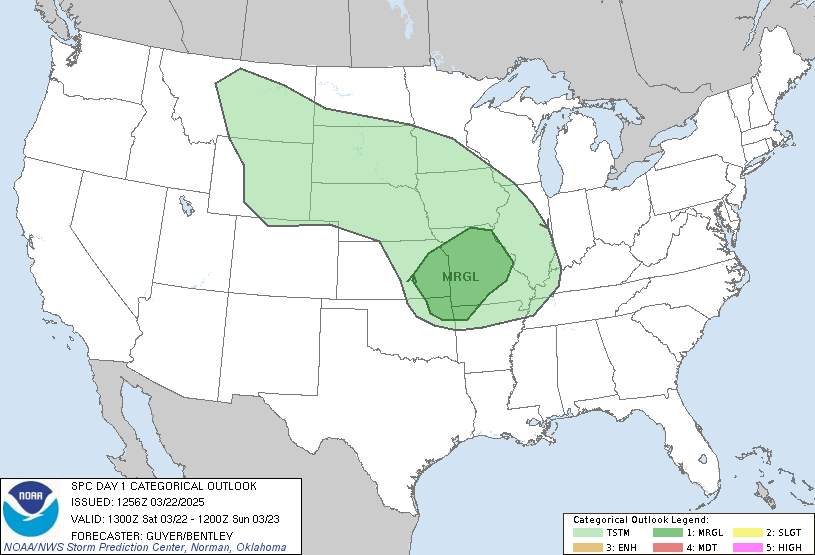
...THERE IS AN ENHANCED RISK OF SEVERE THUNDERSTORMS ACROSS PARTS OF
THE MIDWEST/SOUTHERN GREAT LAKES AND SOUTHERN/CENTRAL PLAINS...
...THERE IS A SLIGHT RISK OF SEVERE THUNDERSTORMS ACROSS PARTS OF
THE NORTHEAST...
...SUMMARY...
Severe thunderstorms are expected this afternoon through tonight
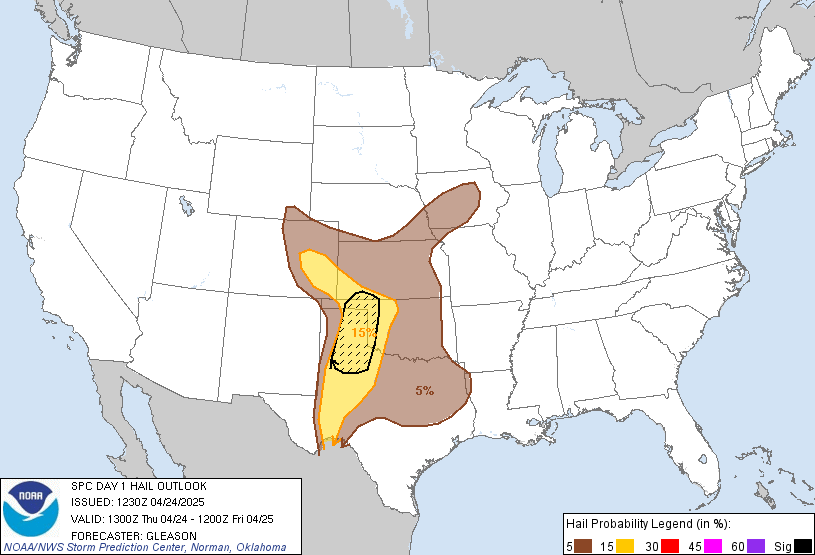
from the southern Plains into the Midwest. Large to giant hail,
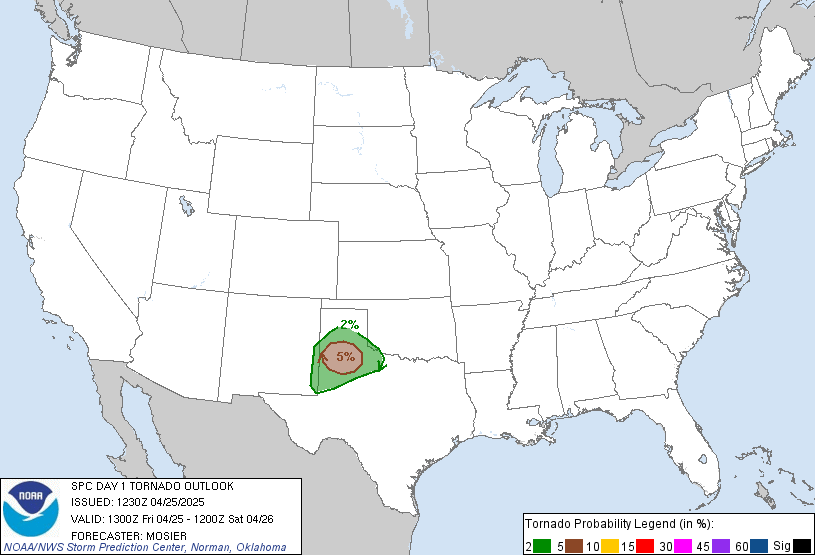
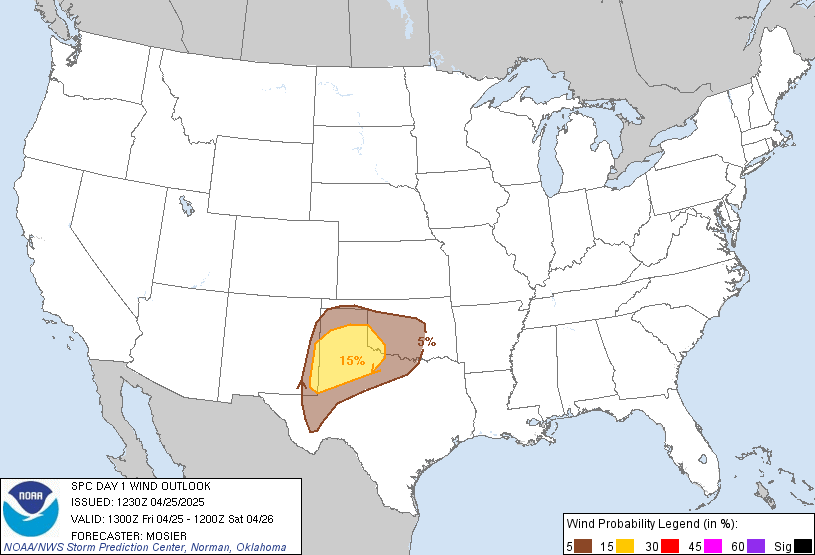
several tornadoes (some strong), and swaths of severe/damaging gusts
are all likely, particularly from Iowa into the southern Great
Lakes.
...Synopsis...
An active severe weather day is anticipated for much of the
southern/central Plains into the Midwest/Great Lakes and parts of
the Northeast. The primary upper trough centered over the Four
Corners late this morning will eject east-northeastward towards the
southern/central Plains by this evening, while a separate mid-level
shortwave trough over the northern Plains/Upper Midwest will also
move east-northeastward across the Upper Great Lakes into Ontario.
Another convectively enhanced low-amplitude shortwave trough will
also develop eastward across the Lower Great Lakes into the
Northeast.
Recent surface analysis indicates multiple surface lows, with one
over southern Ontario and another over southeast NE/northeast KS. A
seasonably rich/moist low-level airmass exists to the south of a
front extending between these two lows, with surface dewpoints
already in the low to mid 60s across much of the southern/central
Plains to the east of a dryline. Both the dryline in the
southern/central Plains and developing warm front in the
Midwest/southern Great Lakes will likely serve as foci for intense
thunderstorms this afternoon and evening, including the potential
for several supercells.
...Midwest/Ohio Valley/Great Lakes...
A complex scenario for severe thunderstorms remains apparent across
the Midwest/OH Valley into the southern Great Lakes today, with
multiple outflow boundaries from earlier convection rendering
greater than usual uncertainty with the southward extent of possible
thunderstorm development in IL/IN/OH. In general, continued
low-level warm advection from the central Plains into the Midwest/OH
Valley will support a moistening/destabilizing airmass through the
afternoon as a northern-stream shortwave trough moves eastward
across the Upper Midwest. A surface warm front will extend
northeastward from a weak surface low in IA across southern WI and
Lower MI. It still appears likely that multiple intense supercells
will develop by 20-21Z along/near this boundary in IA/southern
WI/northern IL in a very favorable airmass for significant severe
hail given strong deep-layer shear and the presence of steep
mid-level lapse rates. Low-level shear is expected to gradually
strengthen through the evening in tandem with a modestly increasing
south-southwesterly low-level jet.
Any supercells than can remain on the warm/south side of the front
will be capable of producing tornadoes, a few of which could be
strong (EF-2/3). Some consideration was given to including greater
tornado probabilities and a Moderate Risk (level 4 of 5) focused
across southern WI/far northern IL. But, convection may have a
tendency to grow upscale fairly quickly this evening, so confidence
was not high enough for a categorical upgrade at this time.
Regardless, very large to giant hail (potentially up to 3-4 inches
in diameter) will be a threat with sustained supercells, and a swath
of severe/damaging winds appears likely with a convective cluster
spreading eastward across southern Lower MI this evening into
tonight.
A somewhat separate area of severe potential should also exist
farther south across central IL into IN/OH this afternoon and
evening. Greater low-level moisture and related instability are
expected to exist across these areas compared to locations farther
north. While large-scale forcing should remain fairly weak/nebulous
across this region, a remnant outflow boundary may provide a focus
for supercell development across central IL into IN by 20-21Z. Have
expanded the Slight Risk for large hail, damaging winds, and perhaps
a few tornadoes southward across these areas to account for this
still somewhat uncertain potential.
...Southern/Central Plains...
12Z observed soundings from DRT/MAF/FWD/OUN/TOP show the presence of
steep mid-level lapse rates atop rich low-level moisture (generally
14-15 g/kg mean mixing ratios) along/east of the surface dryline.
Southwesterly mid-level flow and modest ascent preceding the upper
trough over the Southwest/southern Rockies will gradually overspread
the warm sector by mid to late afternoon. Moderate to strong
instability (MLCAPE around 2000-3000 J/kg, locally stronger
possible) and 35-45 kt of deep-layer shear will support multiple
intense supercells. Explosive convective initiation across parts of
western OK into south-central/southeast KS is expected by 20-21Z as
lingering MLCIN erodes with filtered daytime heating and as
convective temperatures are breached.
The overall thermodynamic and kinematic environment appears quite
favorable for very large to potentially giant hail (up to 3-4 inches
in diameter) with any supercells that spread east-northeastward
through the afternoon/evening. A gradually strengthening low-level
jet across OK/KS by 00Z will also support a threat for a few
tornadoes, a couple of which could be strong as low-level hodographs
become enlarged. Gradual upscale growth/clustering should occur with
time through the evening, with some risk for severe/damaging winds.
The Enhanced Risk has been expanded a bit northeastward into
south-central/southeast KS for a focused severe wind corridor.
Farther south along the length of the dryline in TX, isolated to
scattered supercells may develop this afternoon and evening, with a
risk for mainly large to very large hail and occasional severe
gusts.
...Northeast...
Ongoing convection across southern Ontario and the Lower Great Lakes
will continue to track eastward this afternoon into NY and parts of
New England in tandem with a low-amplitude shortwave trough. Gradual
clearing of low/mid-level clouds has already encouraged surface
temperatures to warm into the 70s along/south of west-east oriented
front. Thunderstorms are expected to gradually increase in coverage
and intensity as weak to locally moderate instability and strong
deep-layer shear support organized updrafts, including the potential
for some supercells initially. The greatest severe risk will
probably be scattered damaging winds given a tendency for convection
to consolidate into one or more clusters. But, an isolated severe
hail threat may exist with any sustained supercell, along with some
chance for a tornado or two near the front where low-level shear
will be locally enhanced.
..Gleason/Chalmers.. 04/14/2026
Read more CHECK UPDATE ZOOM GRAPHIC
http://dlvr.it/TS2Q7Z