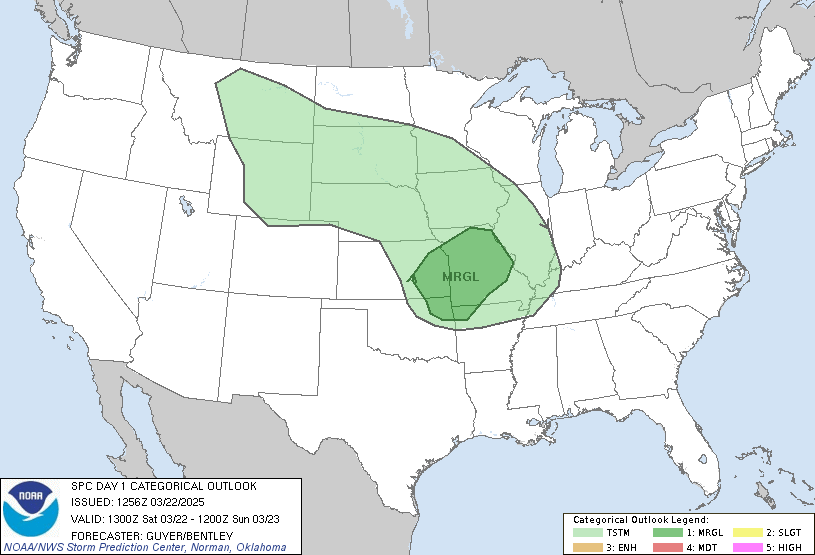
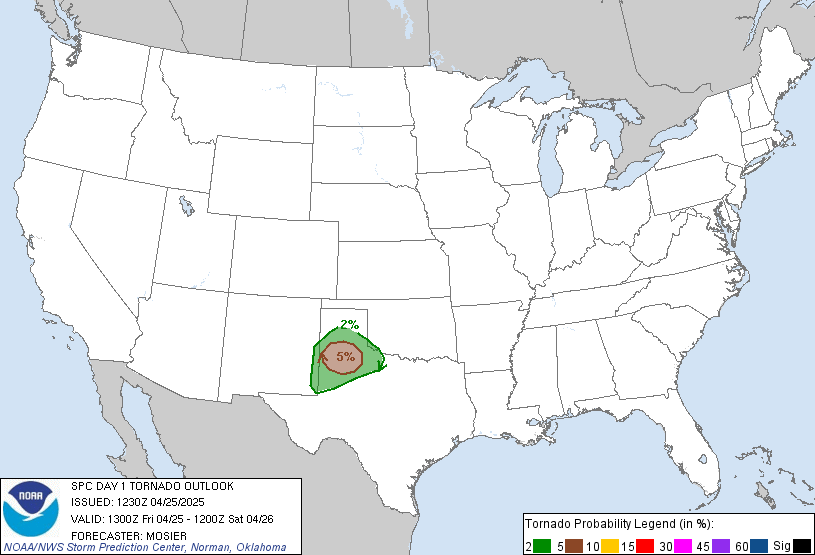
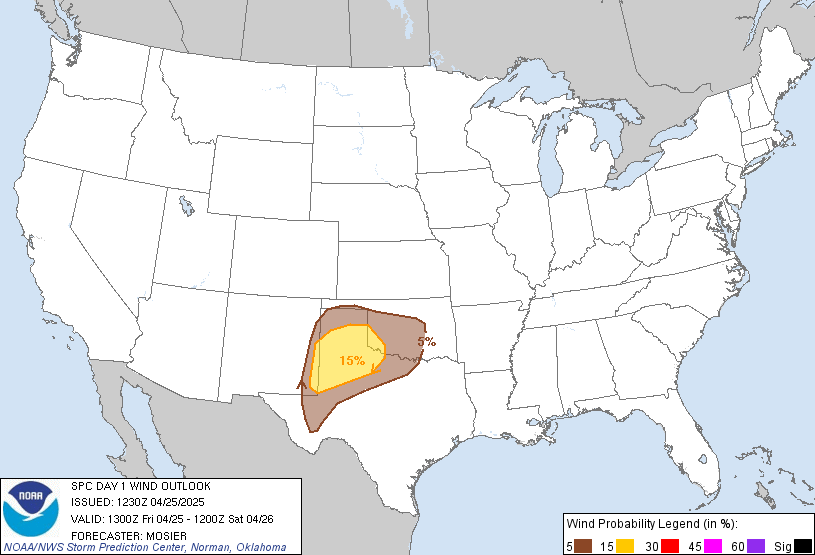
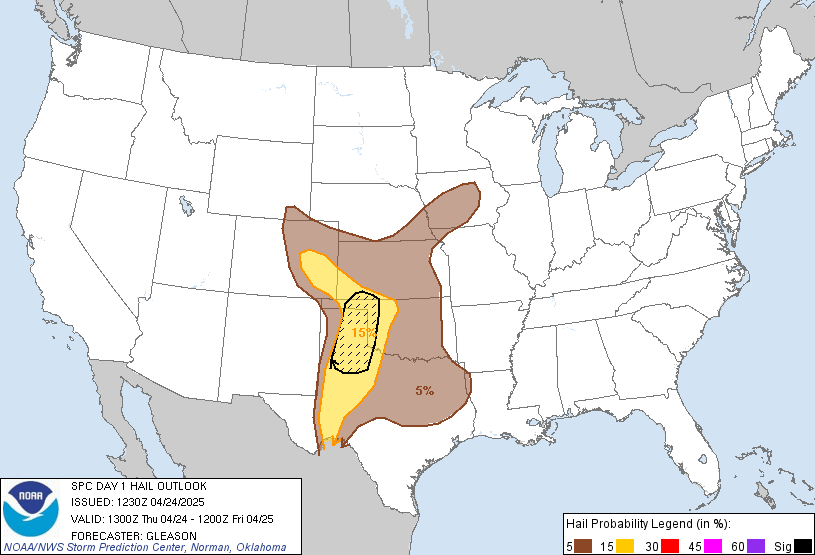
Day 1 Convective Outlook
NWS Storm Prediction Center Norman OK
0256 PM CDT Mon Apr 13 2026
Valid 132000Z - 141200Z
...THERE IS AN ENHANCED RISK OF SEVERE THUNDERSTORMS OVER PARTS OF
SOUTHERN MINNESOTA...NORTHERN IOWA...AND CENTRAL WISCONSIN...
...THERE IS A SLIGHT RISK OF SEVERE THUNDERSTORMS OVER PARTS OF
TEXAS...OKLAHOMA AND THE CENTRAL GREAT LAKES....
...SUMMARY...
Severe thunderstorms remain likely across the Upper Mississippi
Valley and Great Lakes region with potential for large to very large
hail, damaging wind, and tornadoes, mainly late this afternoon into
tonight. A more isolated risk for severe storms is possible across
portions of the southern Plains late this afternoon and evening.
...20z Update Upper Midwest...
Afternoon visible imagery showed diurnal heating ongoing south of
the stalled front from the eastern SD across southern MN into
central WI. Moderate destabilization should support scattered to
numerous thunderstorms this afternoon and evening. Initially
supercells are likely, given strongly veering wind profiles and
moderate deep-layer flow. All hazards are possible with these
storms. With time, upscale growth into one or more lines or clusters
appears likely as storms spread eastward into the Great Lakes.
Convective development appears likely along the triple point near
the surface low from northeast/eastern NE into southeastern SD.
Supercell wind profiles and moderate buoyancy would support a risk
for large hail and some damaging wind gusts. A tornado or two may
occur as any supercells that develop move eastward into deeper
low-level moisture across northwestern IA and southern MN.
...Southern and Central Plains...
Towering cumulus along a dryline over parts of KS/OK/TX may support
isolated storm development late this afternoon. A conditionally
favorable environment (3000+ j/kg of MLCAPE and 35-40 kt effective
shear) for supercells will support a risk for all hazards. See MCD
#399 for short term information. The primary change for this outlook
was to extend severe probabilities northeastward into eastern KS.
Guidance and observational trends have shown an increased likelihood
of a storm or two this afternoon.
..Lyons.. 04/13/2026
.PREV DISCUSSION... /ISSUED 1136 AM CDT Mon Apr 13 2026/
...Upper Mississippi Valley/Great Lakes including MN/WI/IA...
Multiple lead mid-level disturbances over the northern High Plains
will progress northeastward today toward the Upper Midwest, with
strengthening winds aloft across this region particularly late today
and tonight. A surface low will tend to deepen/develop
east-northeastward from northeast Nebraska into far southern
Minnesota and Wisconsin by tonight in vicinity of a
slow-moving/stalled frontal boundary. Low/middle 60s F surface
dewpoints will advect north-northeastward and become increasingly
prevalent along/south of the aforementioned stationary/warm front
this afternoon. MLCAPE values are forecast to reach 2000-2500 J/kg
by around 21z/4pm CDT.
Thunderstorm development will become increasingly probable through
mid/late afternoon (21-00z) as isentropic ascent strengthens ahead
of the approaching upper disturbance. This should especially be the
case near the primary boundary. However, semi-discrete warm sector
supercellular development, across areas such as southern Wisconsin,
cannot be ruled out. Lingering inhibition coupled with 45-50 kt
effective bulk shear should promote initially discrete supercells.
Hodograph elongation appears favorable for a large hail threat,
possibly as large as 2-3 inches in diameter with the more robust
cells. Additionally, enhanced low-level SRH along the frontal zone
is expected to result in a corridor of relatively higher tornado
potential for storms that can remain rooted immediately along the
boundary.
While the overall environment appears very favorable for intense
convection/supercells, east-northeasterly storm motions along or
just north of the warm front will likely promote clustering/upscale
growth through the evening, with an increasing damaging wind
potential and a continued tornado risk via line-embedded
circulations.
...Northern Illinois/northern Indiana and southern Lake Michigan...
See Mesoscale Discussion 395 for short-term details. There is the
potential that a somewhat separate corridor of severe-weather
potential today, potentially via a subtle mid-level wave and morning
convection across northeast Missouri/northwest Illinois vicinity
and/or additional development later today. The initially elevated
storms are on the edge of the east/northeastward-advecting elevated
mixed layer. Steep mid-level lapse rates and 35+ kt effective shear
could support initially isolated hail potential, but a more
organized surface-based severe risk could materialize later this
afternoon, although the specific details remain uncertain.
...Southern Plains including Oklahoma/Texas...
Confidence/potential for isolated to widely scattered locally
intense storms later this afternoon has incrementally increased,
although specifics regarding the extent of convective initiation are
still uncertain.
A moist and potentially unstable air mass will persist regionally to
the east of a dryline located around peak heating from east-central
Kansas south-southwestward into west-central Oklahoma and western
north Texas to the Texas Big Bend vicinity. Immediately east of the
dryline, warm-sector dewpoints are expected to generally be in the
middle 60s F, supporting MLCAPE values to 2500-3000 J/kg. A subtle
disturbance over northern Mexico and the southern Rockies could
approach the dryline/warm sector later today.
Regardless, ample post-dryline mixing and near-dryline
confluence/weak convergence should be sufficient for isolated deep
convective initiation after 21z/4pm CDT. Forecast mass fields and
some short-term guidance would imply that this is most probable
across central/southwest Oklahoma into the north Texas Big Country,
and perhaps somewhat separately across the Texas Big Bend and Rio
Grande vicinity.
If/where storms develop and mature, deep-layer shear on the order of
40+ kt will support supercells, potentially capable of all hazards
including very large hail.
...Northern High Plains...
Generally isolated severe storms including a few low-topped
supercells capable of hail/wind are possible late this afternoon
into evening along/north of the surface front. This is where modest
low-level moisture and vertical shear will be maximized, in the
presence of steep low/mid-level lapse rates.
Read more CHECK UPDATE ZOOM GRAPHIC
http://dlvr.it/TS1dCZ