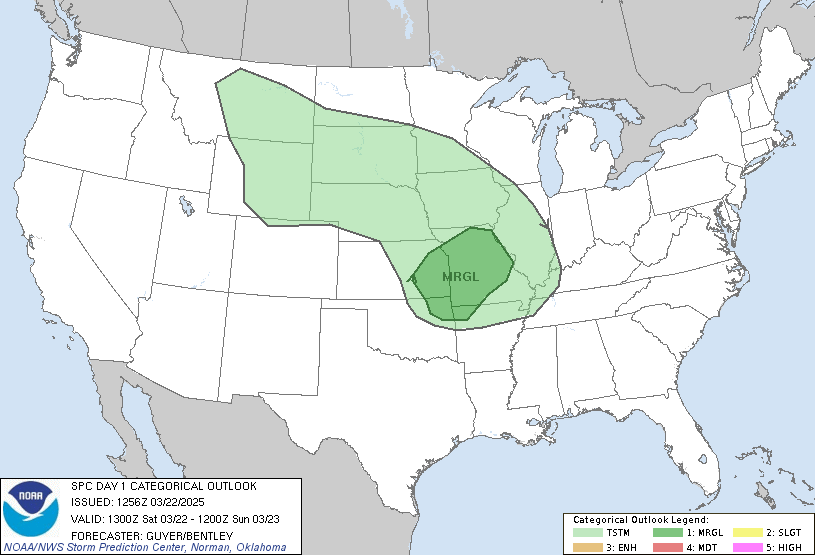
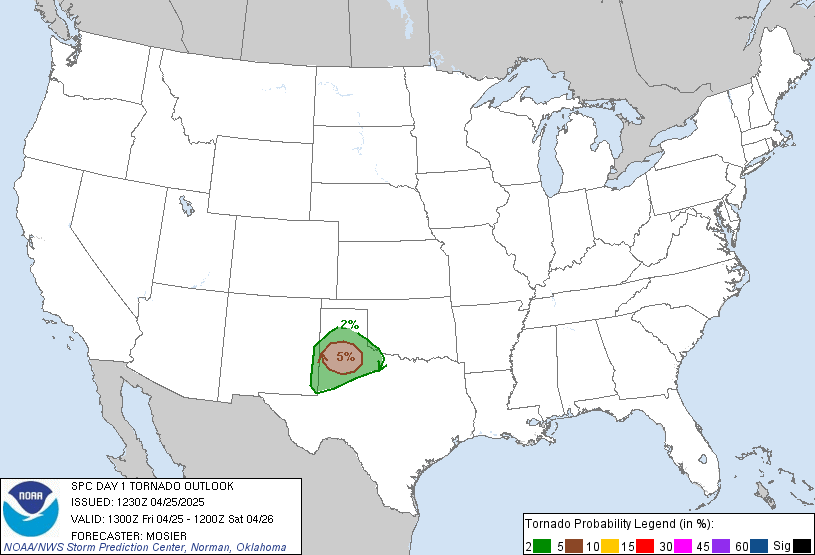
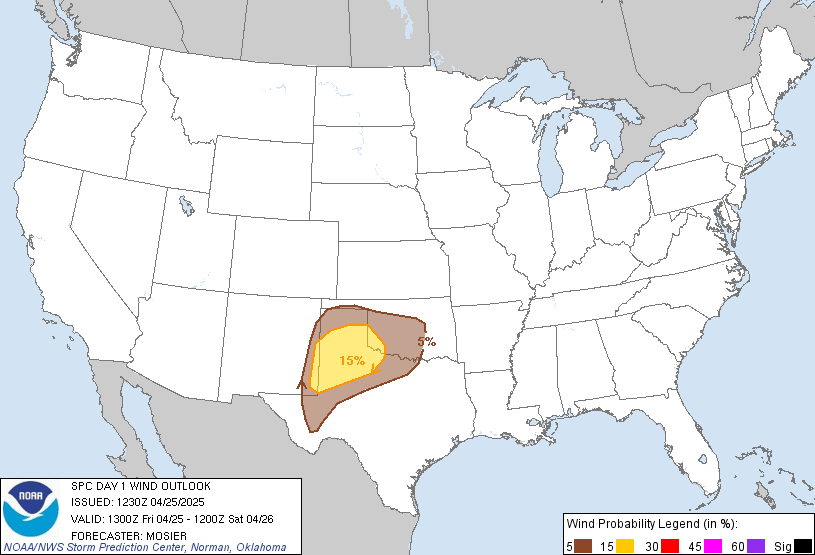
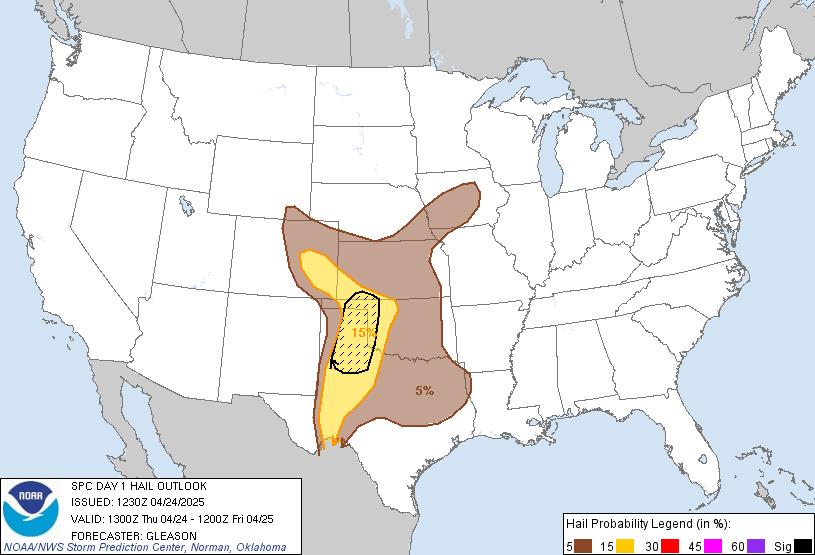
LIVE MAP (ABOVE) ... SPC 2000Z Day 1 Outlook
Day 1 Convective Outlook
NWS Storm Prediction Center Norman OK
0143 PM CST Sun Jan 04 2026
Valid 042000Z - 051200Z
...NO SEVERE THUNDERSTORM AREAS FORECAST...
...SUMMARY...
Severe thunderstorms are not expected through tonight.
...20z Update...
No changes were made to the prior outlook. Isolated thunderstorms
remain possible over parts of the West Coast into the Great Basin,
and over the far southern FL Peninsula through tonight. Weak
buoyancy should preclude any severe risk. See the prior discussion
for more info.
..Lyons.. 01/04/2026
.PREV DISCUSSION... /ISSUED 1014 AM CST Sun Jan 04 2026/
...Discussion...
A progressive/modestly amplified longwave pattern will prevail over
the CONUS through tonight. The primary potential for isolated
thunderstorms will be over the West, generally related to a
weakening shortwave trough that will spread across central
California toward the Great Basin, and a somewhat more prominent
shortwave trough that is just off the coastal Pacific Northwest.
Sporadic, albeit relatively low/isolated, thunderstorm potential
will exist today across the coastal Pacific Northwest toward central
California, and across parts of the Great Basin mainly this
afternoon. The relatively most unstable conditions for the period
are expected to manifest late tonight near the northern California
coast as mid-level lapse rates steepen. However, only a few hundred
J/kg MUCAPE and limited-strength winds through the lowest 3-4km AGL
will likely preclude organized severe storm potential.
Read more CHECK UPDATE ZOOM GRAPHIC
http://dlvr.it/TQ8fDZ
Windy.com Temps | Gusts | WU KORD KPWK |
CLICK for this month's BIG night sky ... | RADAR FULL MAP SCREEN |
|---|
MOBILE DEVICE? Turn sideways. Weather conditions directly above are near Lakefront. Top tabs refer to O'Hare (official).
Archives for the SPC Convective Outlook are updated daily (approximately) with a live map at the beginning of each article. Follow the link at the end of the article to check for current updates on the NOAA/NWS Storm Prediction Center website. Also, see Archives for Chicago's hourly weather data on CARDINAL NEWS Magazine.
CONVECTIVE | TORNADO | WIND | HAIL
O'Hare International Airport KORD
(Arlington Heights South)
Chicago Executive Airport KPWK
(Arlington Heights North)
Sunday, January 4, 2026
SPC Jan 4, 2026 2000 UTC Day 1 Convective Outlook
SPC Jan 4, 2026 1300 UTC Day 1 Convective Outlook
LIVE MAP (ABOVE) ... SPC 1300Z Day 1 Outlook
Day 1 Convective Outlook
NWS Storm Prediction Center Norman OK
0638 AM CST Sun Jan 04 2026
Valid 041300Z - 051200Z
...NO SEVERE THUNDERSTORM AREAS FORECAST...
...SUMMARY...
Widely scattered, generally weak, thunderstorm activity is possible
today across parts of central California and the Pacific Northwest
into portions of the Great Basin.
...Synopsis and Discussion...
Recent satellite imagery shows a pair of shortwave troughs over the
eastern CONUS, one moving through the Northeast and one moving
through the eastern Gulf/FL Peninsula. These waves are forecast to
continue eastward/southeastward today as the modest upper ridging
currently over the central CONUS shifts eastward as well. Some
dampening of this ridging is possible as a shortwave trough moves
from the northern Rockies through the northern Plains and Upper
Midwest. Surface ridging will prevail in the vicinity of these
waves, with the associated stable conditions precluding
thunderstorms. The only exception is across south FL, where enough
low-level moisture will be in place along a weakening frontal
boundary to support a thunderstorm or two.
Upper troughing will gradually deepen over the western CONUS as a
series of shortwave troughs progress across the region. First
shortwave in this series is forecast to reach the central CA Coast
this afternoon before continuing eastward through NV and weakening.
Another shortwave is expected to reach the Pacific Northwest Coast
this evening. This overall evolution will result in mid-level
cooling and persistent forcing for ascent overspreading much of the
region today through tonight. Resulting thermodynamic profiles could
occasionally become marginally conducive for deeper convection
capable of producing lightning.
..Mosier/Bentley.. 01/04/2026
Read more CHECK UPDATE ZOOM GRAPHIC
http://dlvr.it/TQ8Fy1
Day 1 Convective Outlook
NWS Storm Prediction Center Norman OK
0638 AM CST Sun Jan 04 2026
Valid 041300Z - 051200Z
...NO SEVERE THUNDERSTORM AREAS FORECAST...
...SUMMARY...
Widely scattered, generally weak, thunderstorm activity is possible
today across parts of central California and the Pacific Northwest
into portions of the Great Basin.
...Synopsis and Discussion...
Recent satellite imagery shows a pair of shortwave troughs over the
eastern CONUS, one moving through the Northeast and one moving
through the eastern Gulf/FL Peninsula. These waves are forecast to
continue eastward/southeastward today as the modest upper ridging
currently over the central CONUS shifts eastward as well. Some
dampening of this ridging is possible as a shortwave trough moves
from the northern Rockies through the northern Plains and Upper
Midwest. Surface ridging will prevail in the vicinity of these
waves, with the associated stable conditions precluding
thunderstorms. The only exception is across south FL, where enough
low-level moisture will be in place along a weakening frontal
boundary to support a thunderstorm or two.
Upper troughing will gradually deepen over the western CONUS as a
series of shortwave troughs progress across the region. First
shortwave in this series is forecast to reach the central CA Coast
this afternoon before continuing eastward through NV and weakening.
Another shortwave is expected to reach the Pacific Northwest Coast
this evening. This overall evolution will result in mid-level
cooling and persistent forcing for ascent overspreading much of the
region today through tonight. Resulting thermodynamic profiles could
occasionally become marginally conducive for deeper convection
capable of producing lightning.
..Mosier/Bentley.. 01/04/2026
Read more CHECK UPDATE ZOOM GRAPHIC
http://dlvr.it/TQ8Fy1
SPC Jan 4, 2026 0600 UTC Day 1 Convective Outlook
LIVE MAP (ABOVE) ... SPC 1200Z Day 1 Outlook
Day 1 Convective Outlook
NWS Storm Prediction Center Norman OK
1111 PM CST Sat Jan 03 2026
Valid 041200Z - 051200Z
...NO SEVERE THUNDERSTORM AREAS FORECAST...
...SUMMARY...
Widely scattered, generally weak, thunderstorm activity is possible
today across parts of central California and the Pacific Northwest
into portions of the Great Basin.
...Discussion...
Mid-level troughing, digging into and through the northern Mid
Atlantic and Northeast early today, is forecast to quickly turn
eastward offshore and across the Canadian Maritimes through the
remainder of the period, trailed by a more modest perturbation
digging across the Florida peninsula and Bahamas vicinity. A
broadly confluent mid-level regime in its wake is forecast to
support the eastward progression of cool surface ridging into and
across the Atlantic Seaboard, with perhaps some further southward
advancement of the weakening leading edge of the cold air possible
across the southern Florida peninsula and central through
southwestern Gulf Basin.
While mid/upper ridging is likely to be maintained across much of
interior North America, it appears that it will gradually lose
amplitude as a number of smaller-scale perturbations, emerging from
splitting large-scale troughing near the Pacific coast, progress
through it. Across the eastern Pacific into western North America,
models generally indicate that one weakening short wave impulse will
accelerate inland across the central California coast and Sierra
Nevada during the day, trailed inland by a somewhat stronger, but
weakening, perturbation across the Pacific Northwest and Cascades,
in advance of a sharply digging perturbation across the mid-latitude
eastern Pacific.
...Pacific Coast into Intermountain West...
Mid-level cooling and forcing for ascent overspreading the region
today through tonight probably will contribute to the evolution of
thermodynamic profiles occasionally becoming at least marginally
conducive to widely scattered convective development capable of
producing lightning.
...Southern Florida...
Mid-level cooling and forcing for ascent, associated with the
digging short wave trough, might contribute to sufficient
destabilization for an isolated brief thunderstorm or two, mainly
across the interior southern peninsula through southeast coastal
areas late this afternoon.
..Kerr.. 01/04/2026
Read more CHECK UPDATE ZOOM GRAPHIC
http://dlvr.it/TQ83XK
Day 1 Convective Outlook
NWS Storm Prediction Center Norman OK
1111 PM CST Sat Jan 03 2026
Valid 041200Z - 051200Z
...NO SEVERE THUNDERSTORM AREAS FORECAST...
...SUMMARY...
Widely scattered, generally weak, thunderstorm activity is possible
today across parts of central California and the Pacific Northwest
into portions of the Great Basin.
...Discussion...
Mid-level troughing, digging into and through the northern Mid
Atlantic and Northeast early today, is forecast to quickly turn
eastward offshore and across the Canadian Maritimes through the
remainder of the period, trailed by a more modest perturbation
digging across the Florida peninsula and Bahamas vicinity. A
broadly confluent mid-level regime in its wake is forecast to
support the eastward progression of cool surface ridging into and
across the Atlantic Seaboard, with perhaps some further southward
advancement of the weakening leading edge of the cold air possible
across the southern Florida peninsula and central through
southwestern Gulf Basin.
While mid/upper ridging is likely to be maintained across much of
interior North America, it appears that it will gradually lose
amplitude as a number of smaller-scale perturbations, emerging from
splitting large-scale troughing near the Pacific coast, progress
through it. Across the eastern Pacific into western North America,
models generally indicate that one weakening short wave impulse will
accelerate inland across the central California coast and Sierra
Nevada during the day, trailed inland by a somewhat stronger, but
weakening, perturbation across the Pacific Northwest and Cascades,
in advance of a sharply digging perturbation across the mid-latitude
eastern Pacific.
...Pacific Coast into Intermountain West...
Mid-level cooling and forcing for ascent overspreading the region
today through tonight probably will contribute to the evolution of
thermodynamic profiles occasionally becoming at least marginally
conducive to widely scattered convective development capable of
producing lightning.
...Southern Florida...
Mid-level cooling and forcing for ascent, associated with the
digging short wave trough, might contribute to sufficient
destabilization for an isolated brief thunderstorm or two, mainly
across the interior southern peninsula through southeast coastal
areas late this afternoon.
..Kerr.. 01/04/2026
Read more CHECK UPDATE ZOOM GRAPHIC
http://dlvr.it/TQ83XK
Saturday, January 3, 2026
SPC Jan 3, 2026 2000 UTC Day 1 Convective Outlook
LIVE MAP (ABOVE) ... SPC 2000Z Day 1 Outlook
Day 1 Convective Outlook
NWS Storm Prediction Center Norman OK
0152 PM CST Sat Jan 03 2026
Valid 032000Z - 041200Z
...THERE IS A MARGINAL RISK OF SEVERE THUNDERSTORMS OVER PORTIONS OF
THE NORTHERN GULF COAST AND NORTHERN CALIFORNIA INTO SOUTHERN
OREGON....
...SUMMARY...
Isolated severe storms are possible across parts of the Southeast
today. A few severe storms will also be possible from the Sacramento
and northern San Joaquin Valleys to coastal areas of northern
California and southwest Oregon.
...20z Update Southeast...
Overall, only minor changes were made to the prior outlook. Severe
and thunder probabilities were cleared west of a cluster of
thunderstorms ongoing along the northern Gulf Coast from southern
AL/GA into northern FL. Located ahead of a weak cold front, the
environment east of these storms is expected gradually become more
stable owing to remnant cloud cover/precipitation. Still, 500-1000
J/kg of MLCAPE and ~40 kt of deep-layer shear will remain sufficient
for occasional stronger/organized updrafts. Isolated hail, damaging
gusts or a brief tornado are possible, especially with any more
persistent supercell structures able to develop over southern GA and
the FL Panhandle.
...CA...
Several stronger convective elements remain near the coast or just
onshore beneath a strengthening shortwave trough over northern CA
and southern OR. Cool mid-level temperatures (-25C) and strong
frontal forcing will continue to support low-topped storms through
this afternoon. Large-low-level hodographs and strong southwesterly
flow aloft will support an isolated risk for damaging gusts, and
perhaps a brief tornado with any rotating miniature supercell or
QLCS structures moving onshore. Storms should weaken as the cold
front and upper trough move onshore completely this evening.
Farther south, strong ascent, from the aforementioned trough, and
modest surface heating are supporting weak destabilization over the
northern San Joaquin Valley. Favorable low-level hodograph curvature
and buoyancy could support an isolated low-topped supercell capable
of a brief tornado this afternoon. See the prior outlook for
additional info.
..Lyons.. 01/03/2026
.PREV DISCUSSION... /ISSUED 1038 AM CST Sat Jan 03 2026/
...Southeast...
Multiple shortwave troughs currently over the Mid-South/Lower
Mississippi Valley will continue to progress southeastward across
the region today. A relatively moist air mass precedes a weak
surface low and south/southeastward-advancing front, with a band of
scattered convection also a notable pre-frontal factor across
northern Florida and far southern Georgia. This convection and weak
near-frontal convergence should effectively limit severe potential
to its north, while potential severe storm development should be
more probable on its western flank across southern Alabama and the
Florida Panhandle and eventually other parts of far northern
Florida.
Low-level flow will tend to remain veered ahead of the front,
limiting low-level hodograph curvature. Even so, strong mid-level
westerly/southwesterly flow will extend across the region, resulting
in long hodographs that could support occasional organized updrafts.
Primary severe risk will be isolated damaging gusts, although a
low-probability risk for a brief tornado exists as well. Some
isolated hail could also occur, particularly with any storms near
the surface low over southern Alabama and the western Florida
Panhandle during the late afternoon/early evening.
...Northern/Central California and Southwest Oregon...
A shortwave trough will continue to move east-northeastward and
inland over the region today. Modestly broken clusters of
thunderstorms have somewhat increased offshore this morning, with
the lead portion of these storms, including a few low-topped
rotating storms, located around 25-50 miles off the far northern
California coast as of 16z/8am PST. With a strong deep-layer wind
field, a few of these stronger, more organized, and potentially
rotating storms could move inland through midday with damaging wind
and/or waterspout/brief tornado potential. For additional short-term
details, see Mesoscale Discussion 4.
Additionally, into the afternoon, southerly low-level flow through
the Sacramento and northern San Joaquin Valleys, could result in
enough low-level curvature for an isolated low-topped supercell
capable of a brief tornado.
Read more CHECK UPDATE ZOOM GRAPHIC
http://dlvr.it/TQ7x1q
Day 1 Convective Outlook
NWS Storm Prediction Center Norman OK
0152 PM CST Sat Jan 03 2026
Valid 032000Z - 041200Z
...THERE IS A MARGINAL RISK OF SEVERE THUNDERSTORMS OVER PORTIONS OF
THE NORTHERN GULF COAST AND NORTHERN CALIFORNIA INTO SOUTHERN
OREGON....
...SUMMARY...
Isolated severe storms are possible across parts of the Southeast
today. A few severe storms will also be possible from the Sacramento
and northern San Joaquin Valleys to coastal areas of northern
California and southwest Oregon.
...20z Update Southeast...
Overall, only minor changes were made to the prior outlook. Severe
and thunder probabilities were cleared west of a cluster of
thunderstorms ongoing along the northern Gulf Coast from southern
AL/GA into northern FL. Located ahead of a weak cold front, the
environment east of these storms is expected gradually become more
stable owing to remnant cloud cover/precipitation. Still, 500-1000
J/kg of MLCAPE and ~40 kt of deep-layer shear will remain sufficient
for occasional stronger/organized updrafts. Isolated hail, damaging
gusts or a brief tornado are possible, especially with any more
persistent supercell structures able to develop over southern GA and
the FL Panhandle.
...CA...
Several stronger convective elements remain near the coast or just
onshore beneath a strengthening shortwave trough over northern CA
and southern OR. Cool mid-level temperatures (-25C) and strong
frontal forcing will continue to support low-topped storms through
this afternoon. Large-low-level hodographs and strong southwesterly
flow aloft will support an isolated risk for damaging gusts, and
perhaps a brief tornado with any rotating miniature supercell or
QLCS structures moving onshore. Storms should weaken as the cold
front and upper trough move onshore completely this evening.
Farther south, strong ascent, from the aforementioned trough, and
modest surface heating are supporting weak destabilization over the
northern San Joaquin Valley. Favorable low-level hodograph curvature
and buoyancy could support an isolated low-topped supercell capable
of a brief tornado this afternoon. See the prior outlook for
additional info.
..Lyons.. 01/03/2026
.PREV DISCUSSION... /ISSUED 1038 AM CST Sat Jan 03 2026/
...Southeast...
Multiple shortwave troughs currently over the Mid-South/Lower
Mississippi Valley will continue to progress southeastward across
the region today. A relatively moist air mass precedes a weak
surface low and south/southeastward-advancing front, with a band of
scattered convection also a notable pre-frontal factor across
northern Florida and far southern Georgia. This convection and weak
near-frontal convergence should effectively limit severe potential
to its north, while potential severe storm development should be
more probable on its western flank across southern Alabama and the
Florida Panhandle and eventually other parts of far northern
Florida.
Low-level flow will tend to remain veered ahead of the front,
limiting low-level hodograph curvature. Even so, strong mid-level
westerly/southwesterly flow will extend across the region, resulting
in long hodographs that could support occasional organized updrafts.
Primary severe risk will be isolated damaging gusts, although a
low-probability risk for a brief tornado exists as well. Some
isolated hail could also occur, particularly with any storms near
the surface low over southern Alabama and the western Florida
Panhandle during the late afternoon/early evening.
...Northern/Central California and Southwest Oregon...
A shortwave trough will continue to move east-northeastward and
inland over the region today. Modestly broken clusters of
thunderstorms have somewhat increased offshore this morning, with
the lead portion of these storms, including a few low-topped
rotating storms, located around 25-50 miles off the far northern
California coast as of 16z/8am PST. With a strong deep-layer wind
field, a few of these stronger, more organized, and potentially
rotating storms could move inland through midday with damaging wind
and/or waterspout/brief tornado potential. For additional short-term
details, see Mesoscale Discussion 4.
Additionally, into the afternoon, southerly low-level flow through
the Sacramento and northern San Joaquin Valleys, could result in
enough low-level curvature for an isolated low-topped supercell
capable of a brief tornado.
Read more CHECK UPDATE ZOOM GRAPHIC
http://dlvr.it/TQ7x1q
Subscribe to:
Comments (Atom)
SUNRISE AND SUNSET TIMES IN UTC (if you're not logged in to Google)
CHICAGO UTC-6 during CST (Central Standard Time, e.g., winter)
CHICAGO UTC-5 during CDT (Daylight Savings Time, e.g., summer)
CHICAGO UTC-6 during CST (Central Standard Time, e.g., winter)
CHICAGO UTC-5 during CDT (Daylight Savings Time, e.g., summer)